
Diocesan Corpus Christi Procession
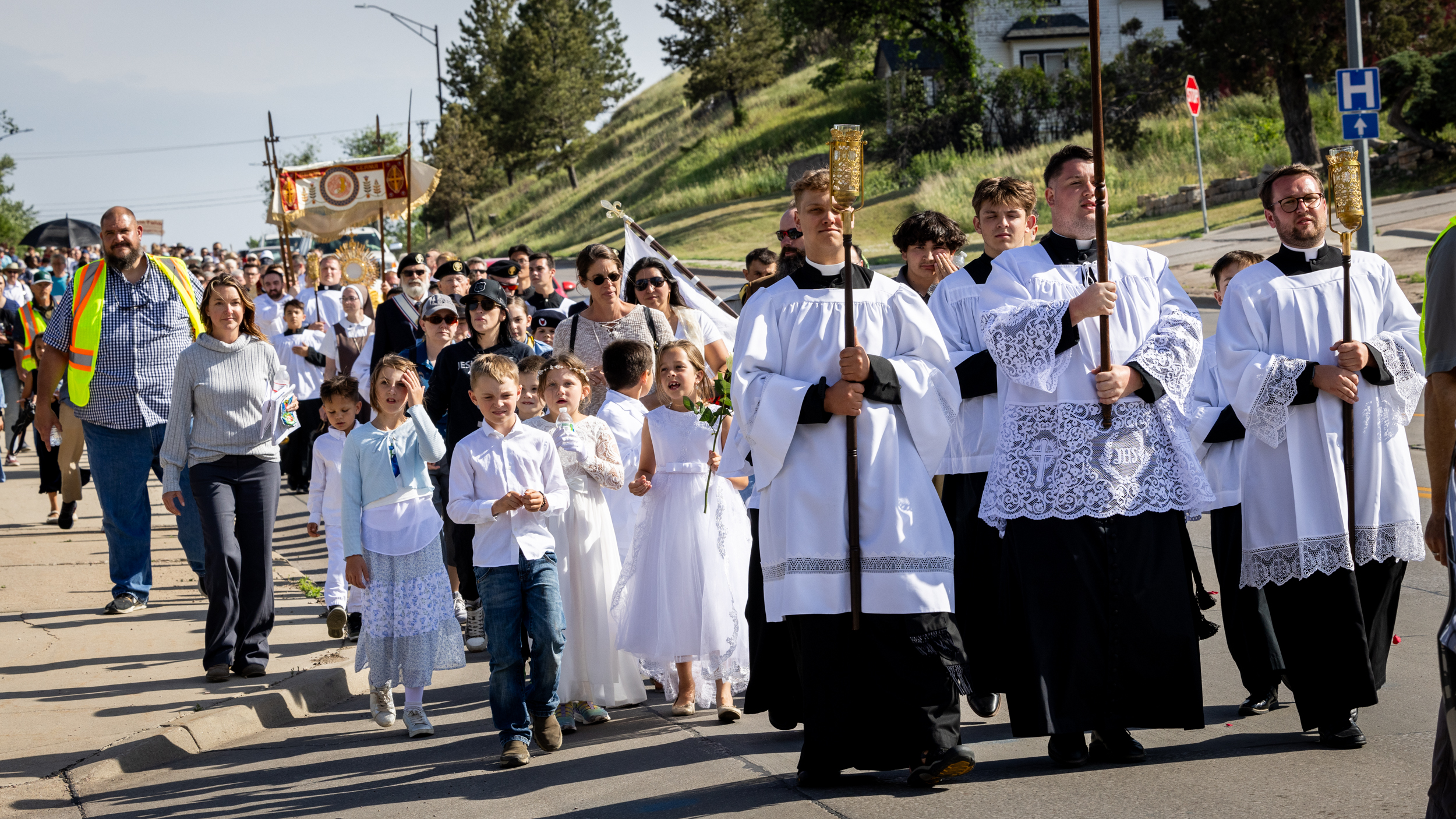
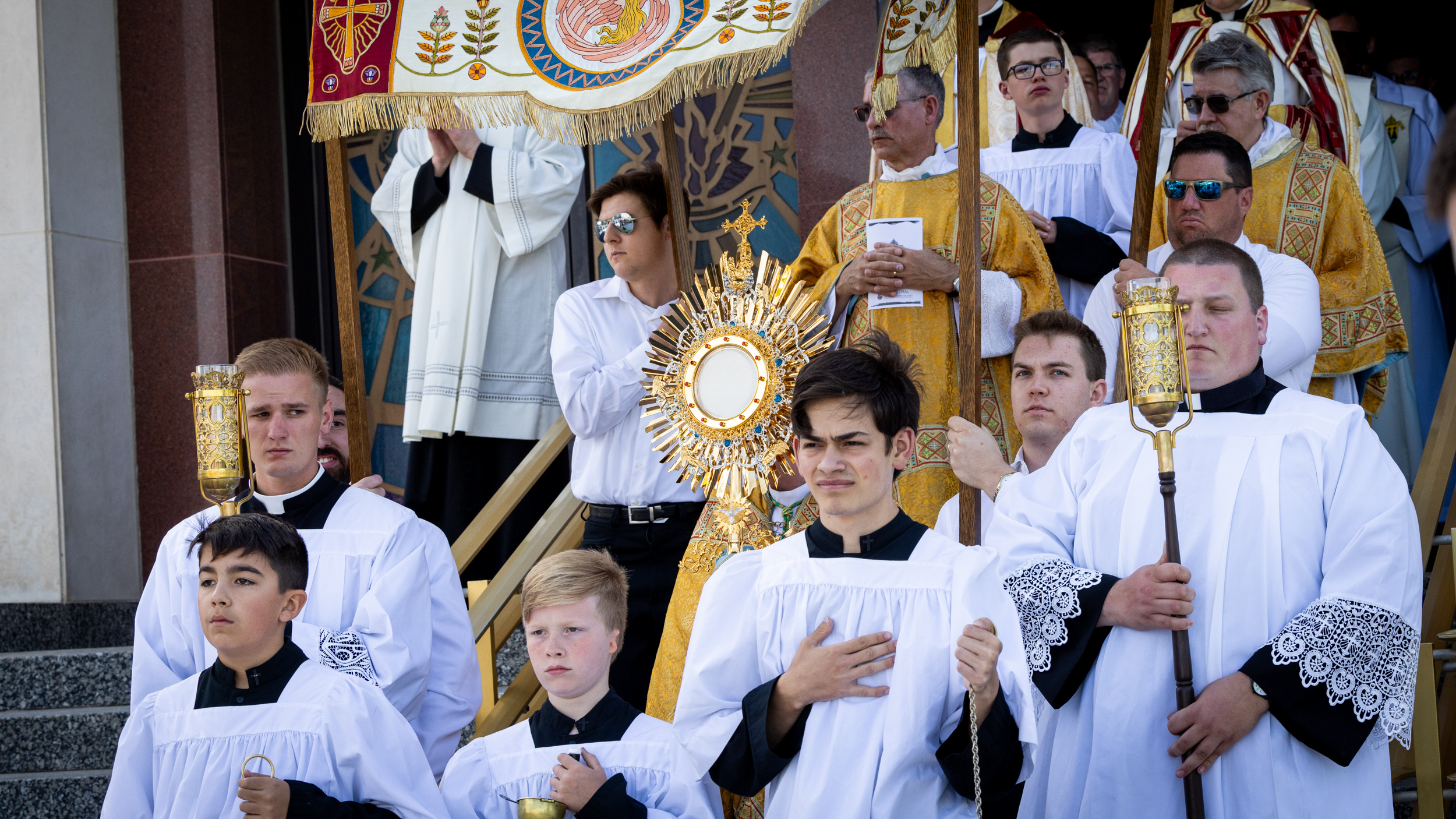
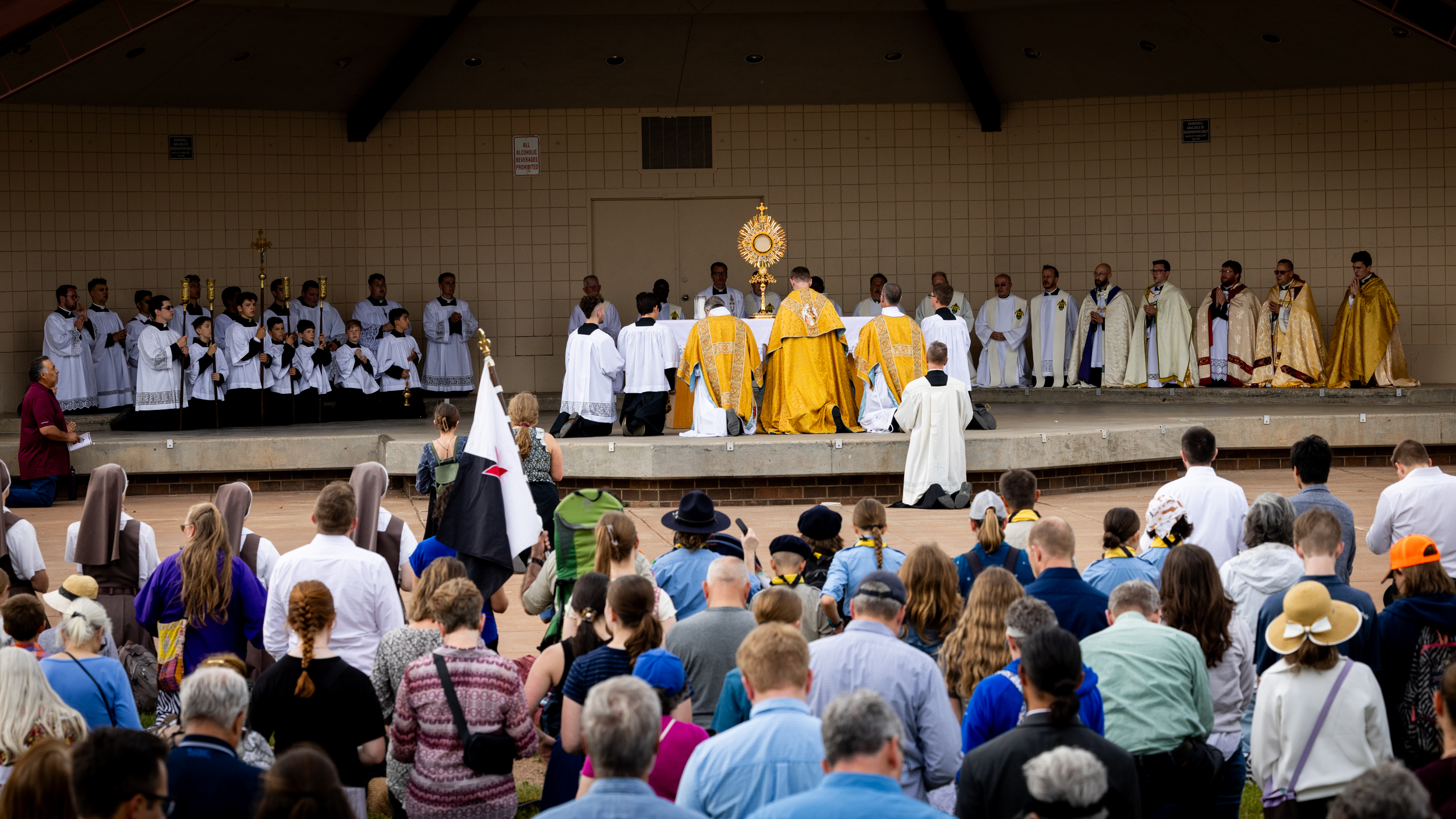
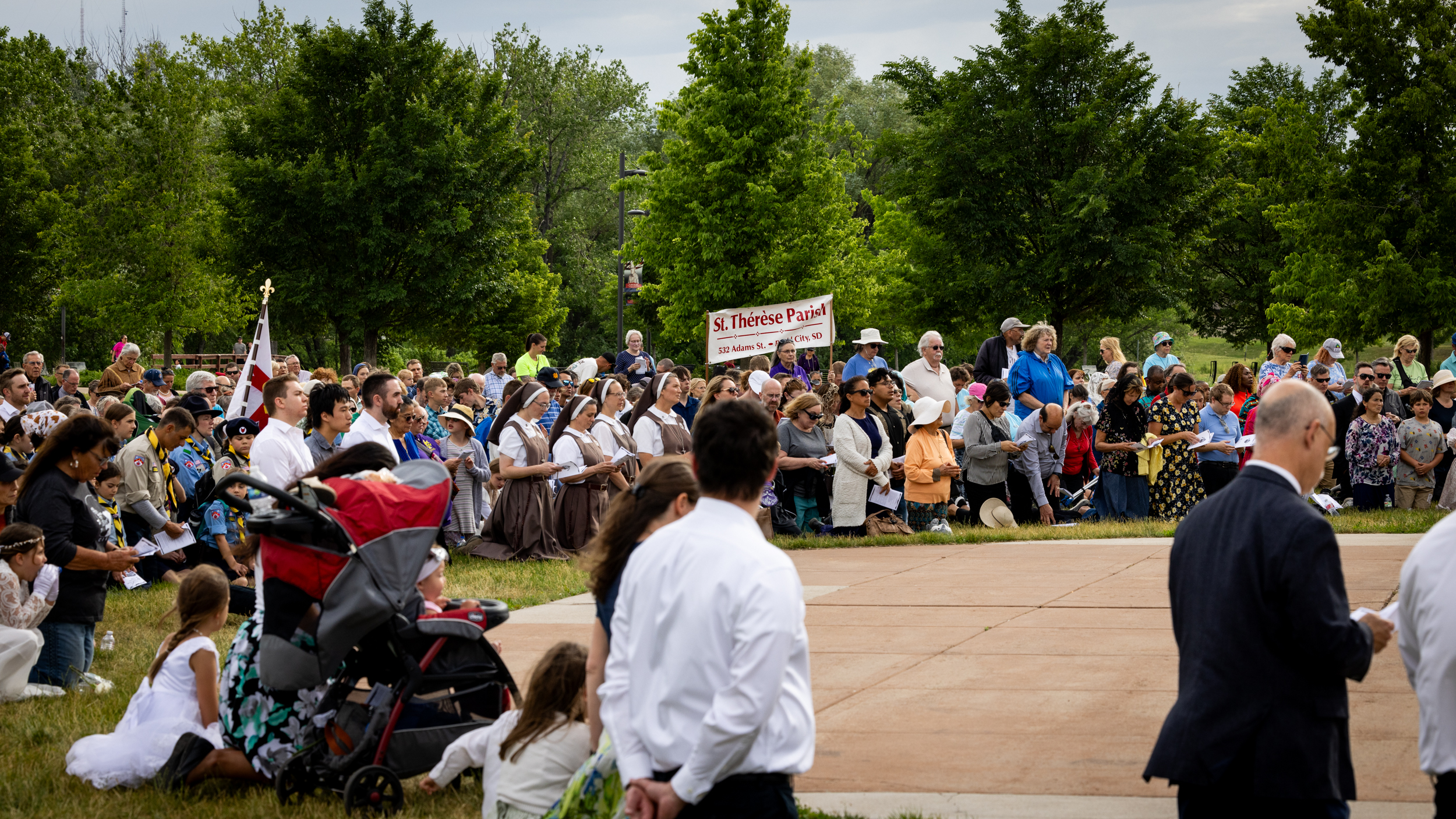
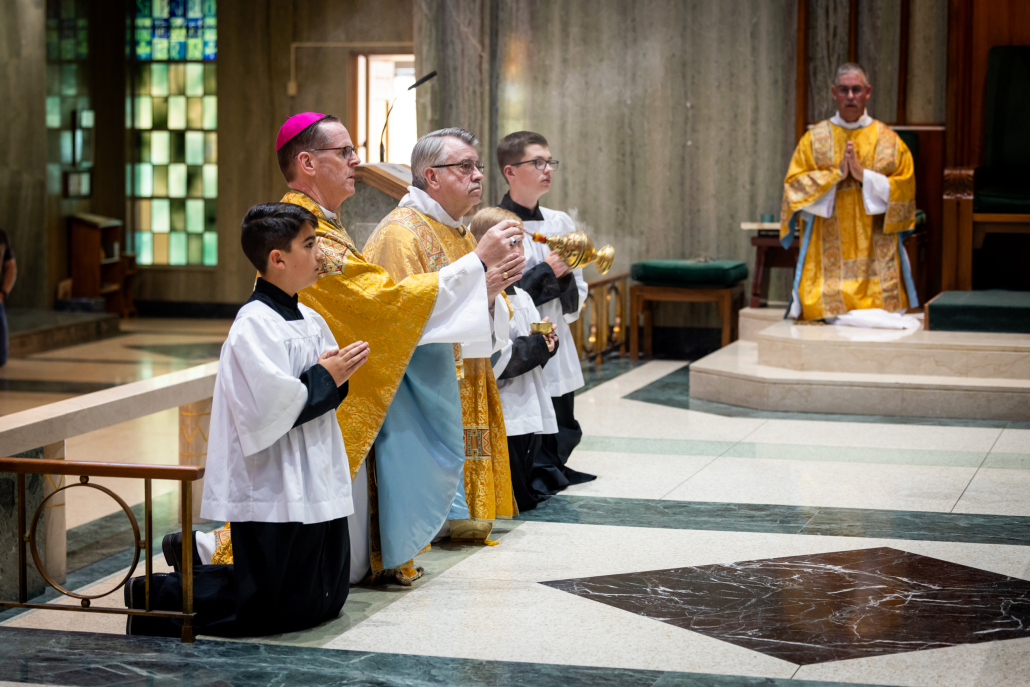
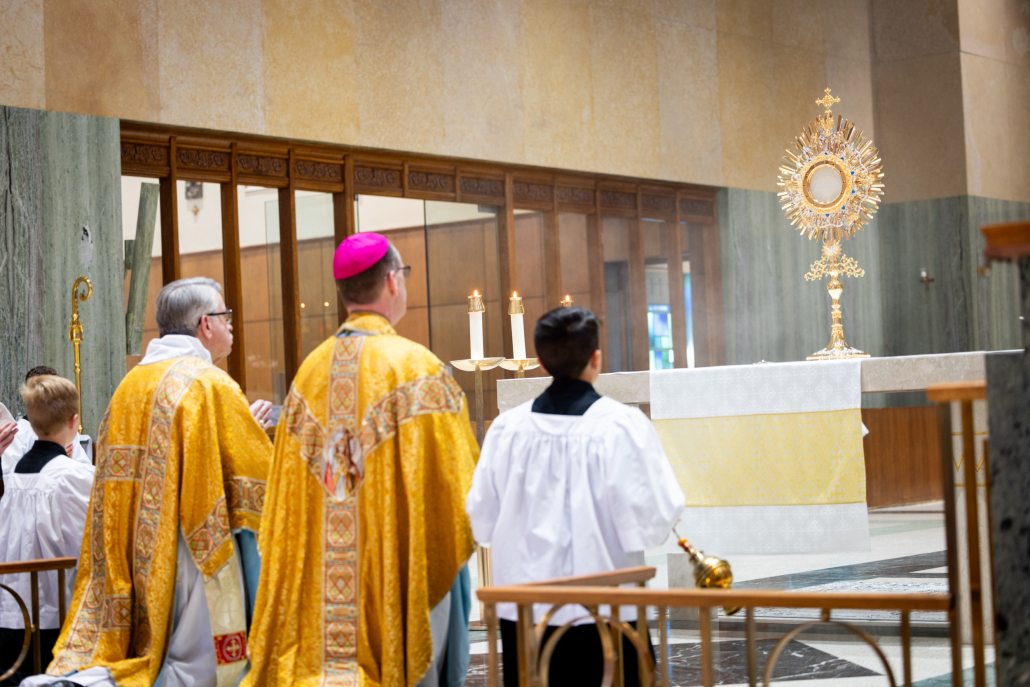
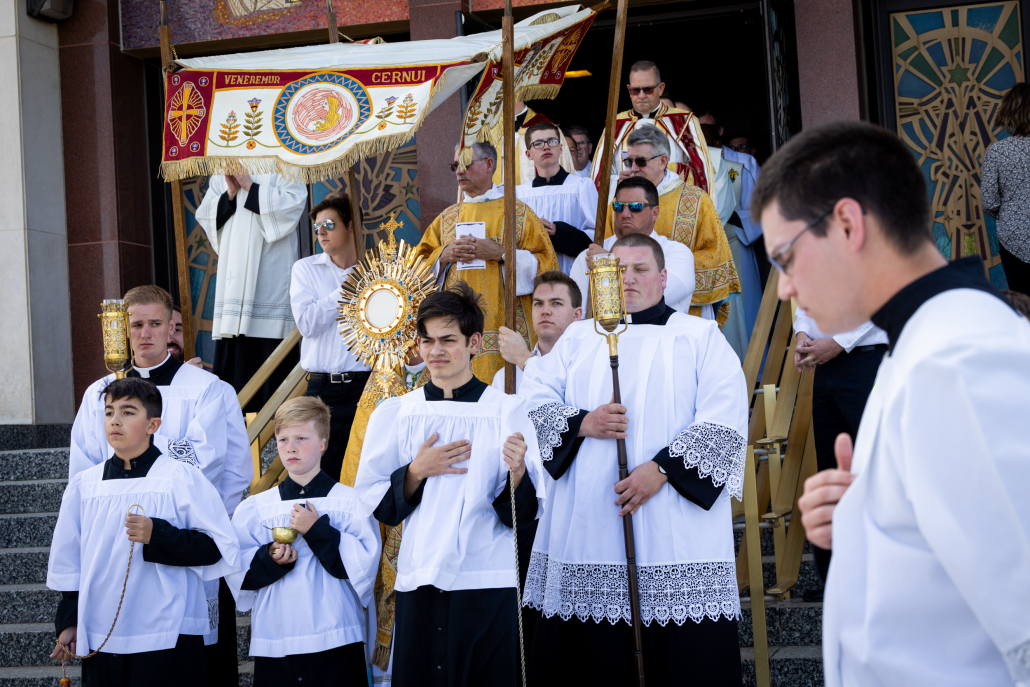
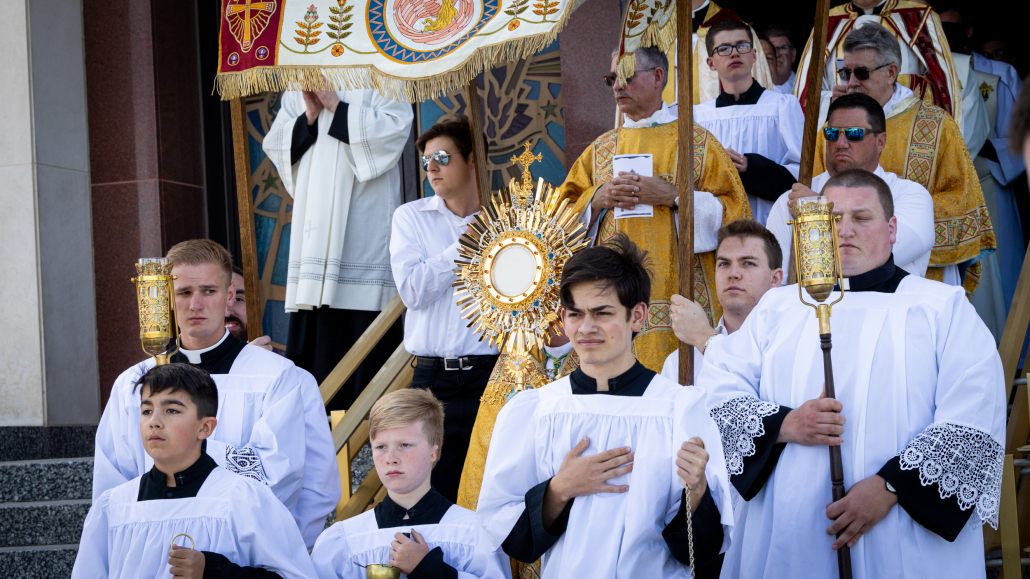
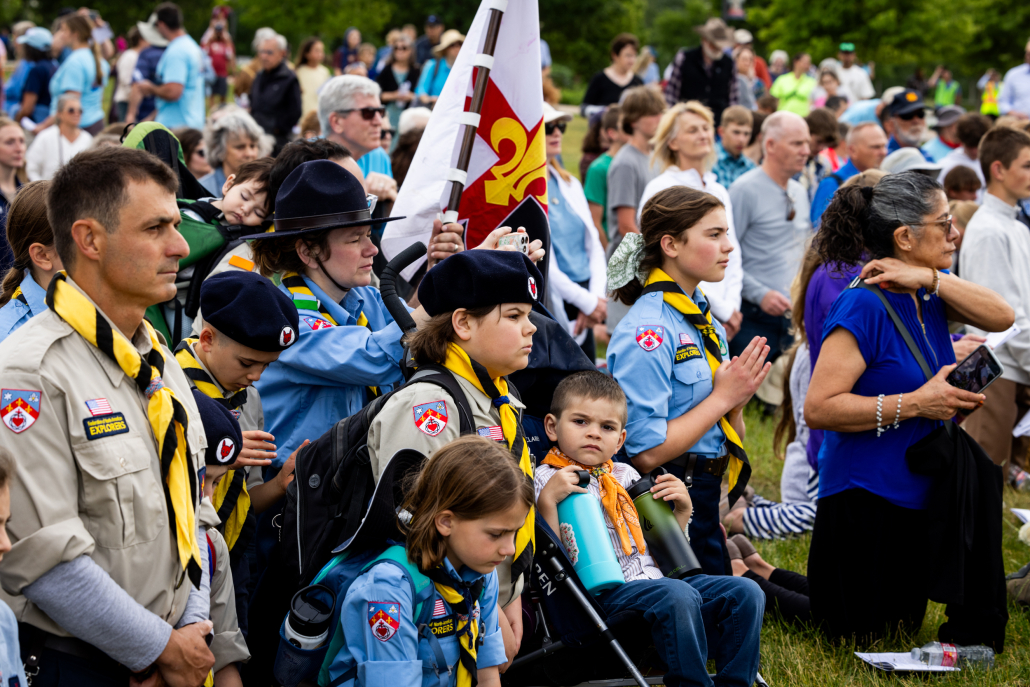
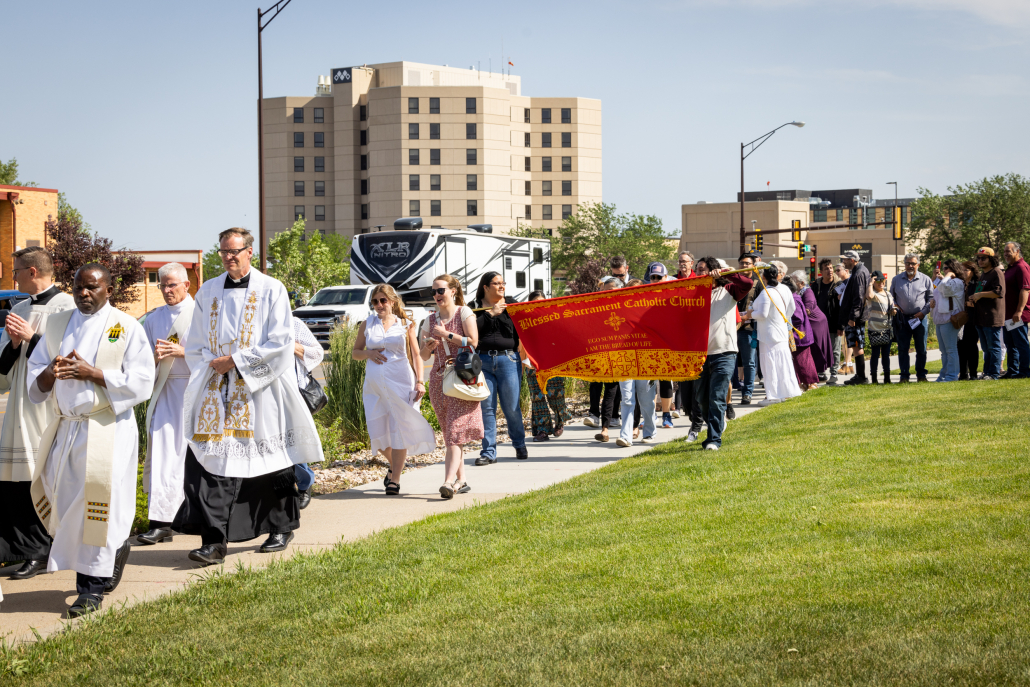
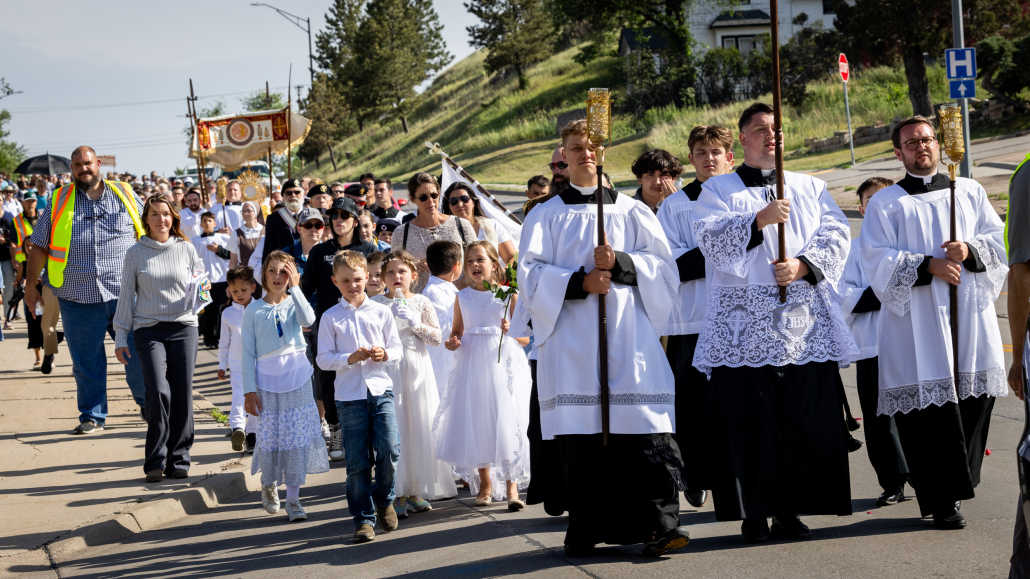
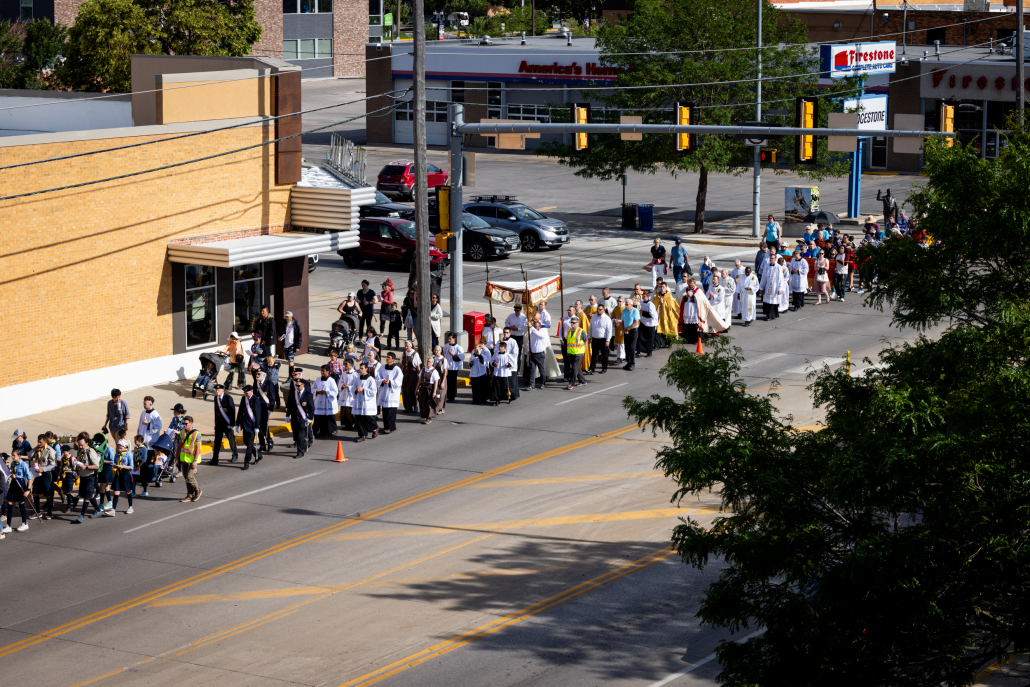
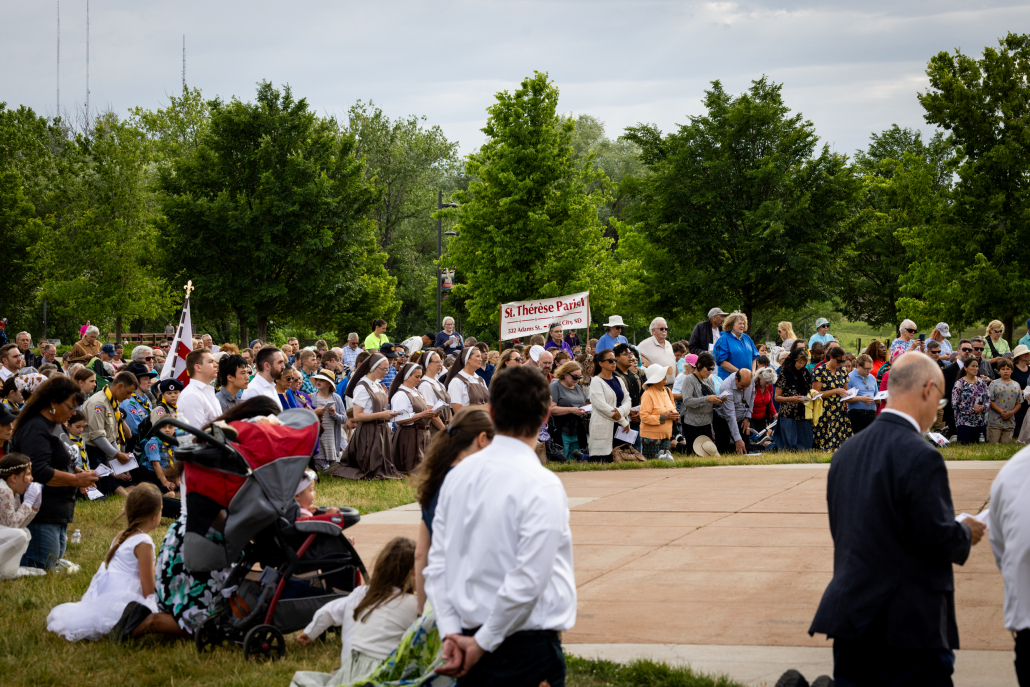
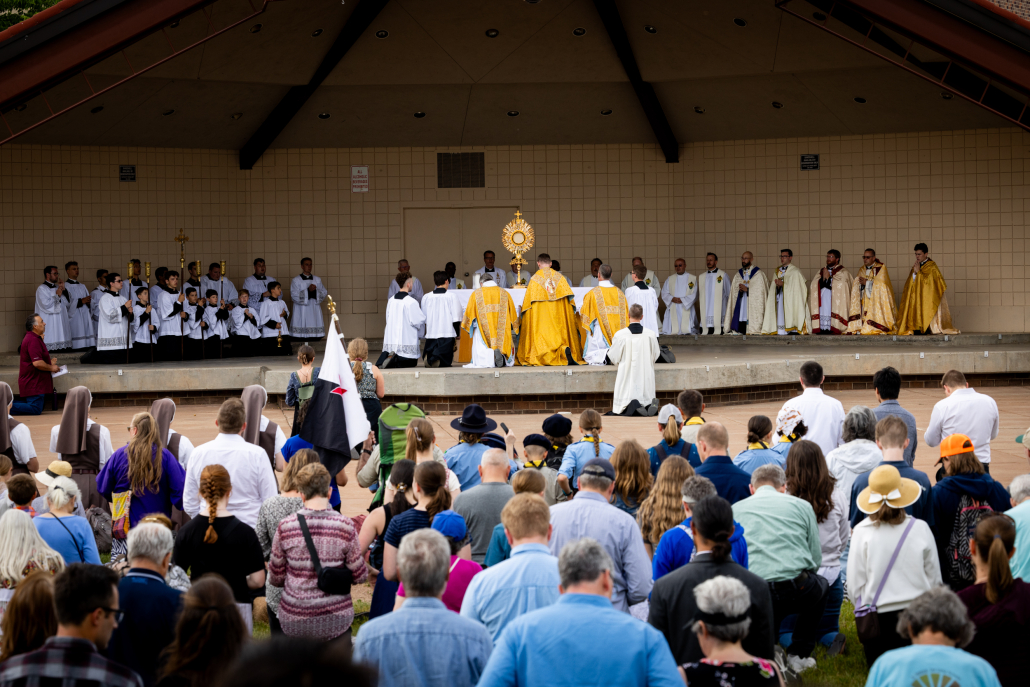
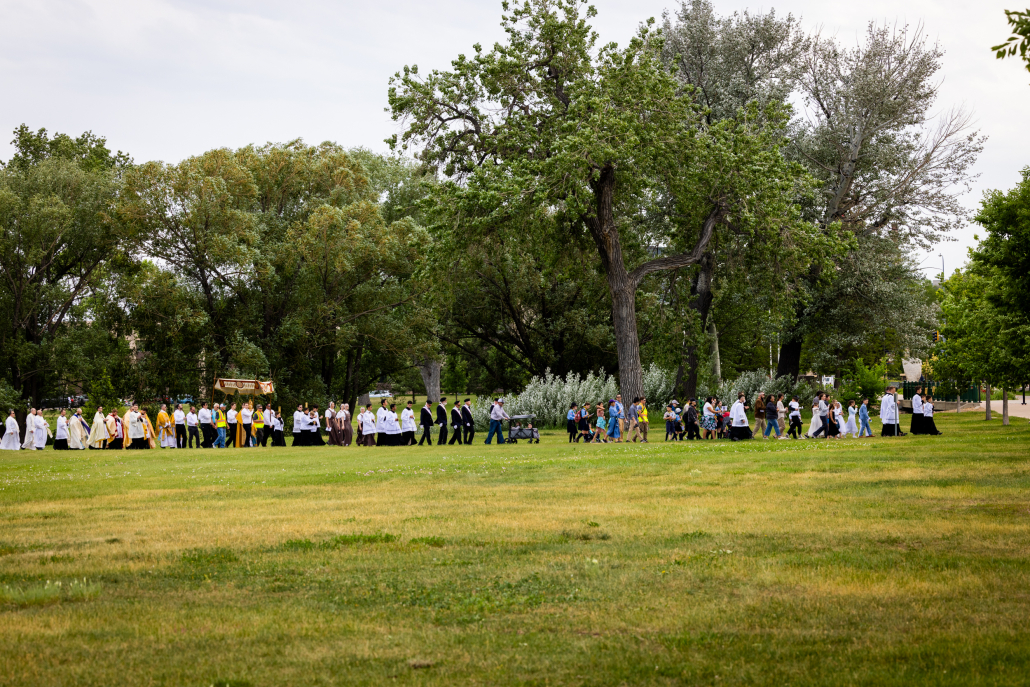
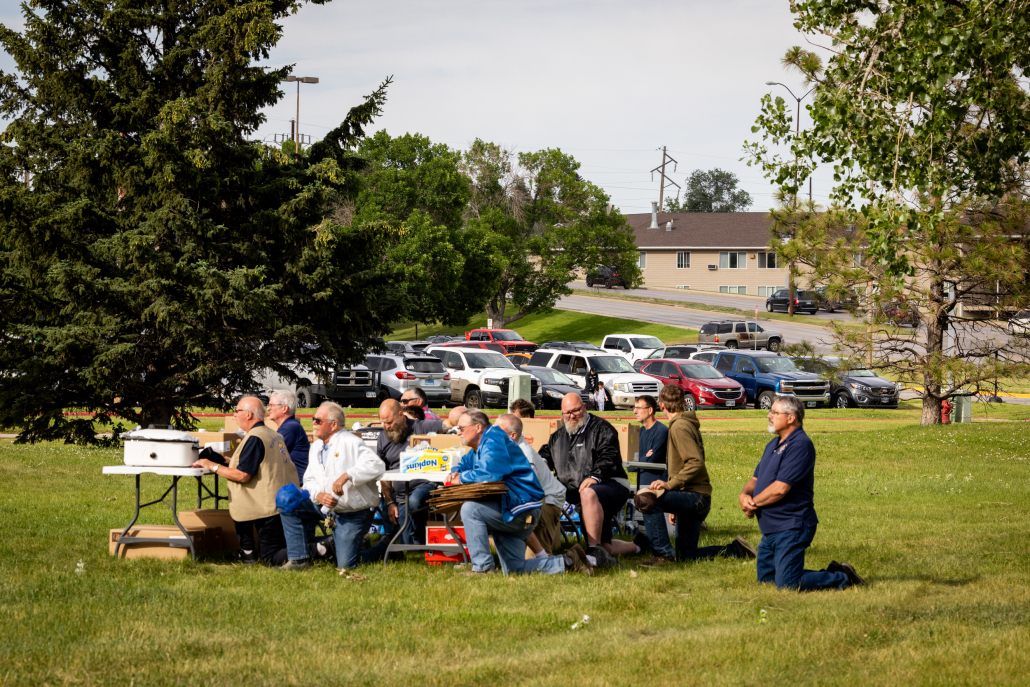
To celebrate the “Year of Missionary Sending of the National Eucharistic Revival,” the Diocese of Rapid City held a Eucharistic Procession on a prominent Rapid City thoroughfare. Bishop Scott Bullock celebrated Mass at the Cathedral of Our Lady of Perpetual Help in the afternoon, June 22, on the Feast of Corpus Christi. Cathedral Rector, Fr. Brian Christensen, directed the local and out-of-town people to line up in the south parking lot, and some churches had banners for their parishioners to cluster around. Several hundred people followed the canopy with the monstrance along 5th St., which runs the length of the city. Singing and praying they were accompanied by a police escort at the front and rear of the worshipers. The route took them from the cathedral to the Memorial Park Bandshell for Benediction. About halfway, there was a water station at Immaculate Conception Church. The pastor, Fr. Gregory Bartholomew, FSSP, kept the church bell tolling as the group went by. When the procession was over, approximately 500 people stayed for a picnic supper hosted by the Knights of Columbus. The National Eucharistic Revival, which began on the Solemnity of Corpus Christi 2022, has been a national movement to rekindle in the faithful a love for Jesus in the Eucharist. This culminating Year of Sending began with a national congress attended by thousands of people from around the country. Busloads of adults and youth from the Diocese of Rapid City participated in these fruitful days of Mass, adoration, presentations, and transformative pilgrimage together. This year has been focused on inviting the faithful to take Jesus, whom they have encountered and grown closer to, out to the rest of the world. From the national website: “The Holy Spirit has enkindled a missionary fire in the heart of our nation, and now he is sending out every member of the Church to spread the Good News – sharing the gift of our Eucharistic Lord with those on the margins.”
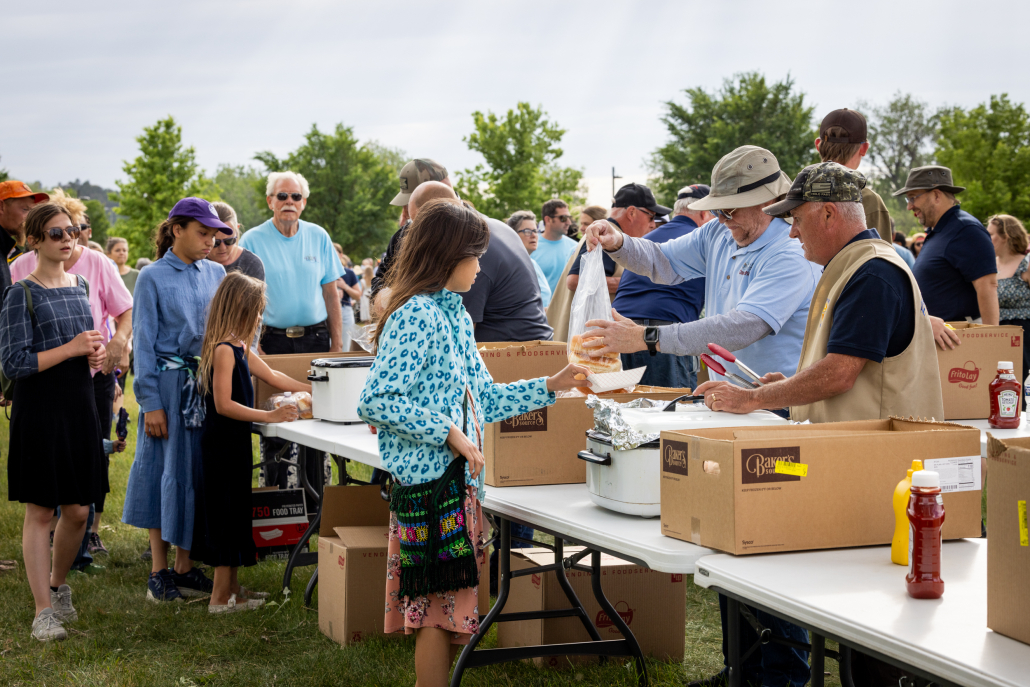
Parish Processions
St. Rose of Lima, Hill City
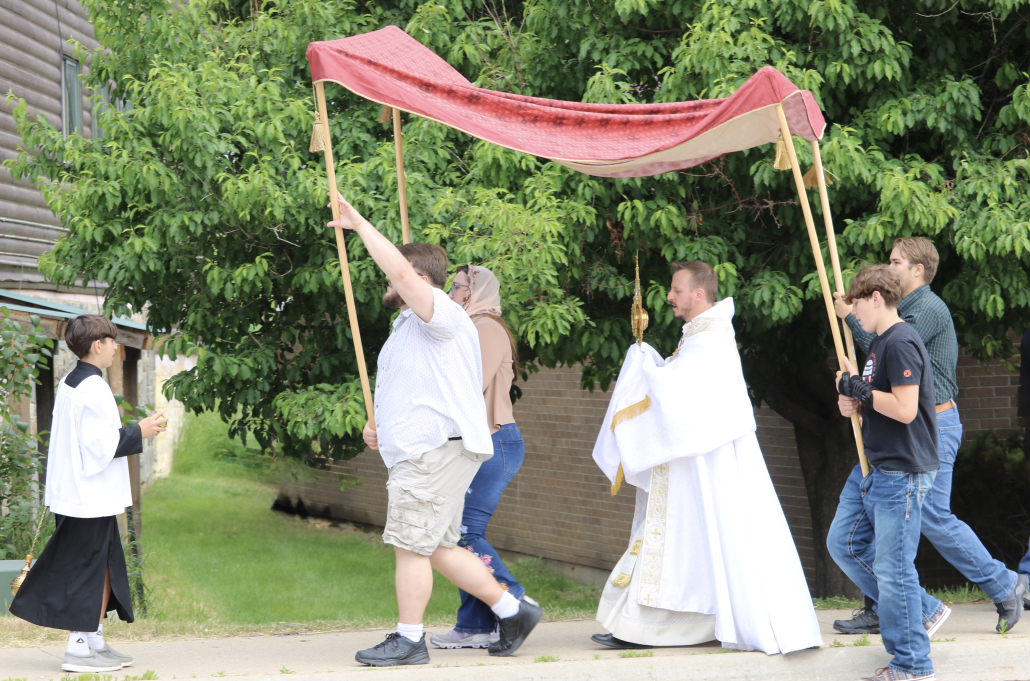
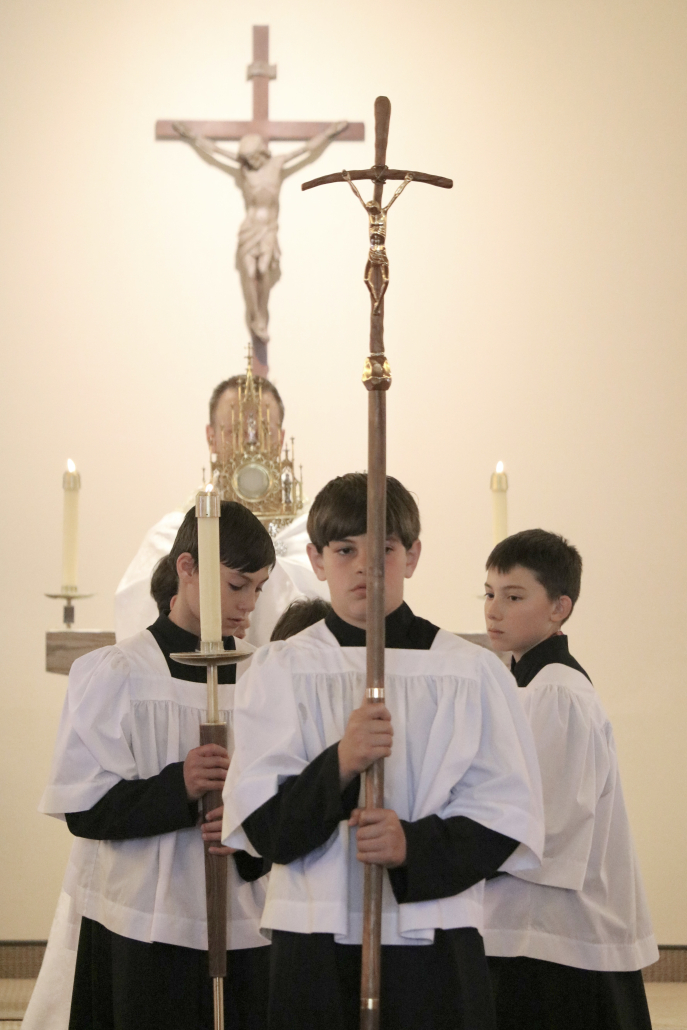
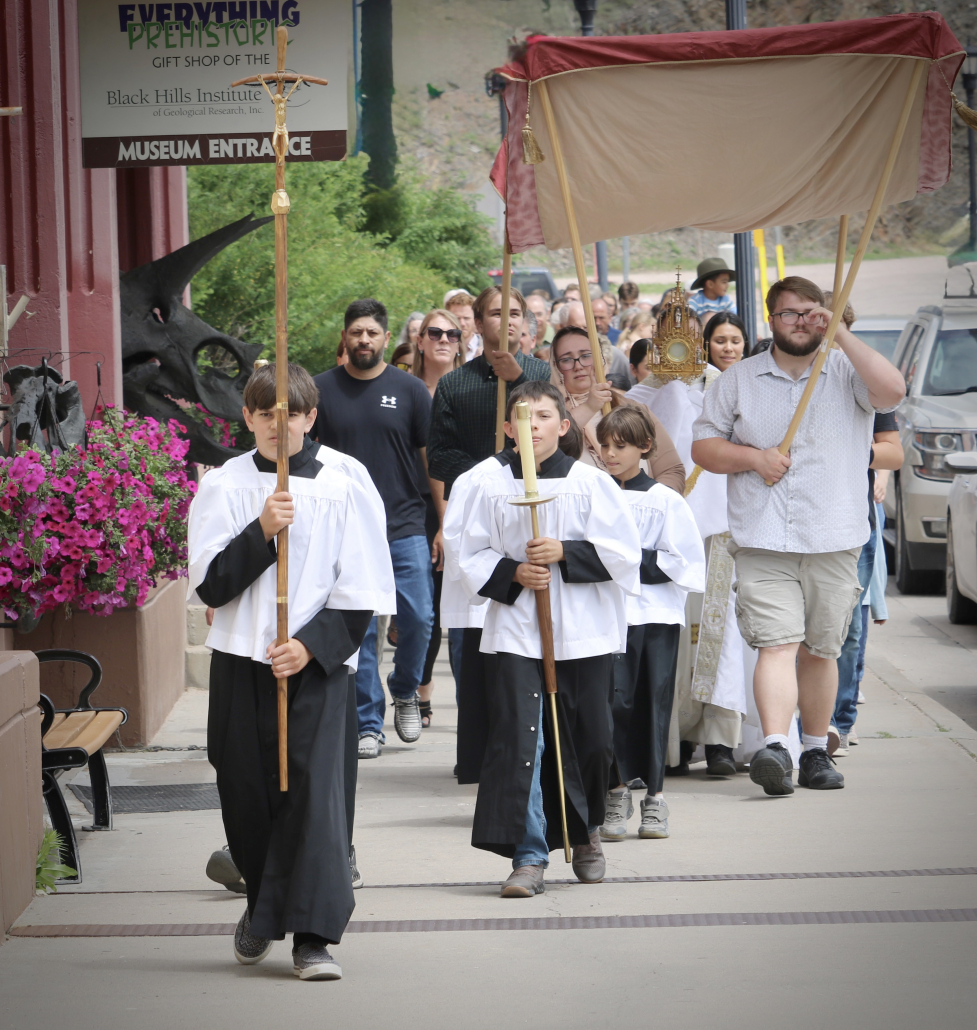
St. Ambrose, Deadwood, and St. Patrick, Lead
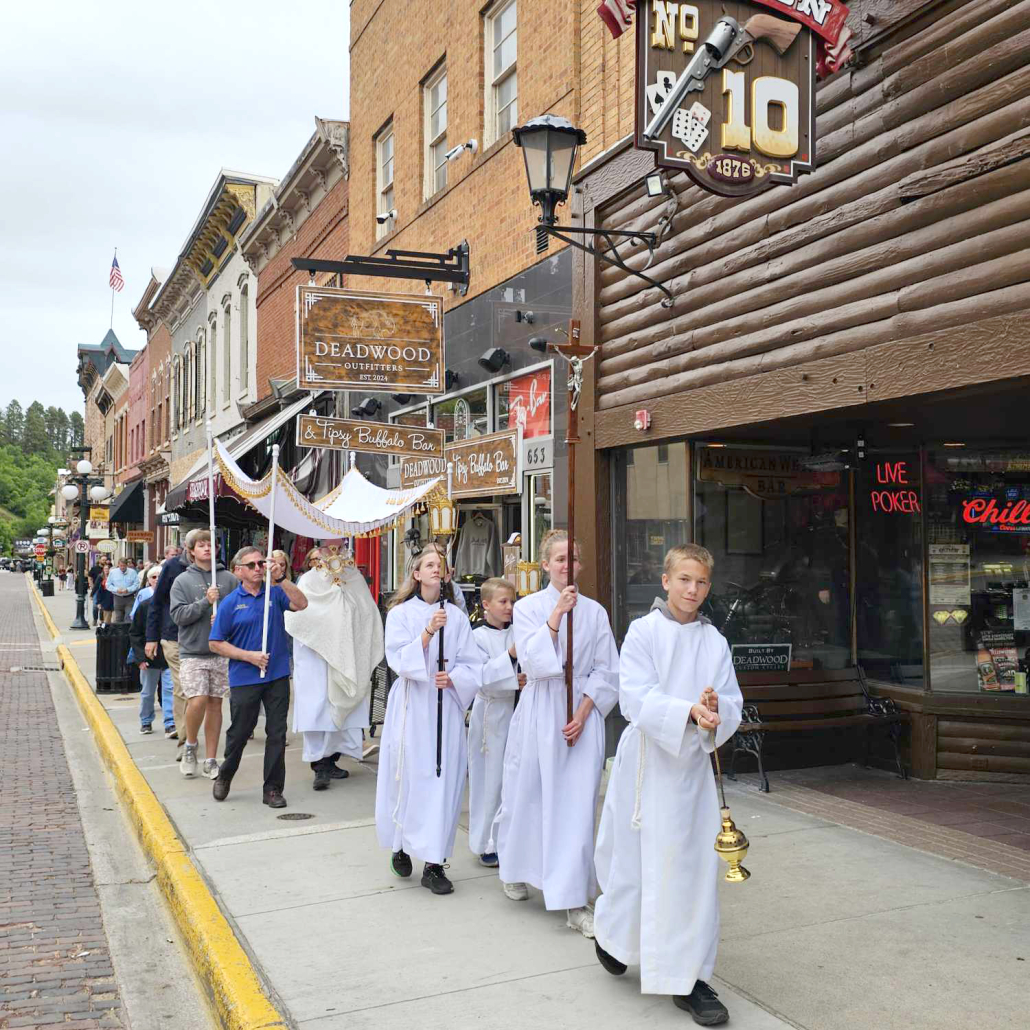
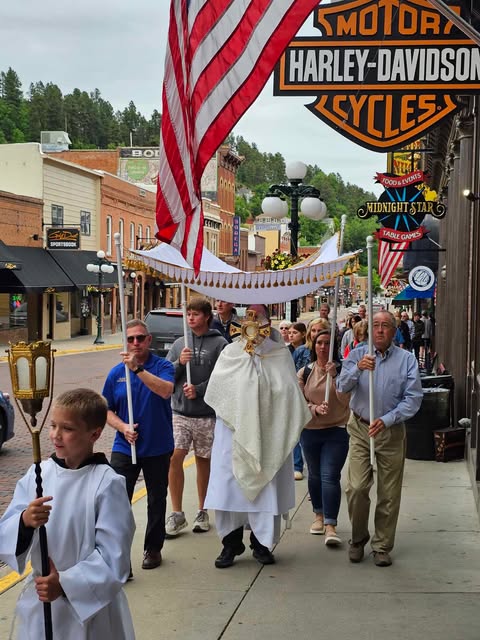
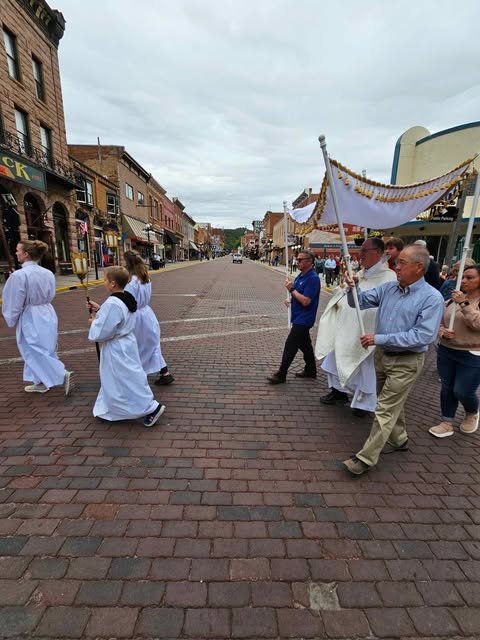
St. Mary, Milesville
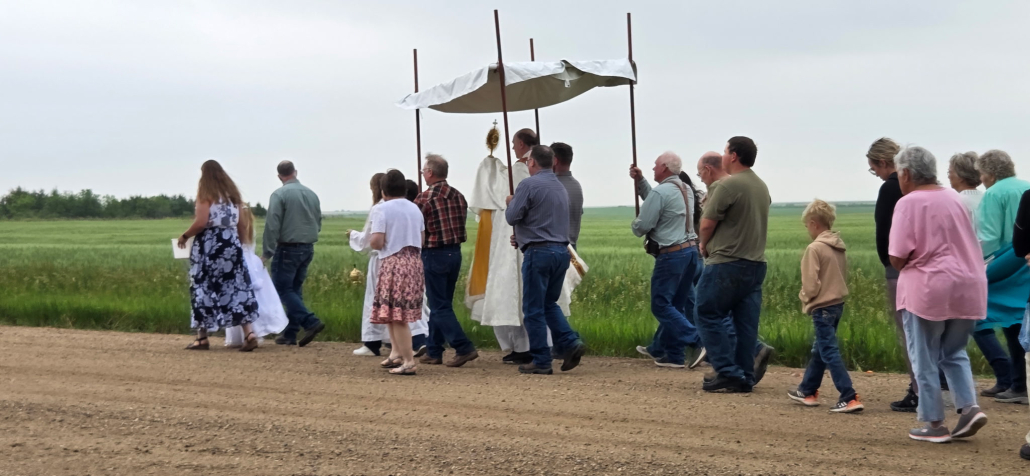
Corpus Christi Mass with Bishop Bullock
Watch the Mass
Listen to the homily
Read the homily
We’re hungry creatures, aren’t we? Think about how much of our day we think about hunger; how we want to feed ourselves. That’s the way we were created — to be hungry. But hungry for what?
With the death of my father back in April, I got to thinking about my good parents — my mother preceded him in death by nine years — and how much they had done for me and my siblings. It also occurred to me how much they both wanted to have children, and, at the same time, I wondered, did they concern themselves at that time about the extent of the effort that would be required to nurture the children they had begat? For they were giving birth to three hungry creatures: my brother, my sister, and myself. What followed our births were countless hours of work for my dad, where he earned the money which my mother used to prepare countless meals for us kids. My dad, who had a nice sense of humor, really got the sense of this effort when we, his adult children, his sons and daughter, would return home for a visit in his later years and would ultimately find ourselves at dad’s favorite restaurant. At the end of the meal, there was never any question — he was paying. And his favorite line, once we thanked him for the meal, was this: “The law says I have to feed you.” I’m sure there was no law requiring him to feed us in our 60s except for one law — the law of love which impelled him to nurture us all the way through our lives, long after any civil law required the feeding of his children.
It is the same law of love at work in today’s Gospel, where Jesus, God’s perfect love, is driven to feed his children in an extraordinary sign of abundant love. Let’s take a minute and notice carefully how Jesus feeds the crowd of 5,000. Here, in summary, is what the Gospel writer Luke recounts about how Jesus feeds the crowd. He tells us Jesus first speaks to them. He speaks to them about the kingdom of God. Then he heals them. Then he gives them a food that satisfies. And finally, we’re told, in an important detail, that twelve wicker baskets of leftover fragments remained.
First Jesus, in wanting to feed us, he speaks to the crowd. There’s more than one Biblical word for speak. In this situation, this specific word, to speak, suggests an abundance of words — to speak at great length. Here we get the sense of the abundance of the teacher Jesus. While some might be tempted to criticize the preacher for going on too long, no one thought about that with Jesus for he had abundant words for the crowd because he so desired to tell them about the breadth, and the height, and depth of God’s love. The abundance of God’s mercies which we call the Kingdom of God.
This sense of feeding begins with a feast of Jesus’ speaking, reflecting the deep, divine desire to convert all hearts to a confidence in the perfect love and mercy of the Father.
The feast continues as Jesus heals them, we’re told. Here he is restoring their hope, feeding them with the ultimate sign of the presence of God. A restoring healing. The literal meaning of this Biblical word is to “be made whole.” People have come to the feast and they’re not yet whole and Jesus wants them to be restored. So, when an infirmity has fractured a person, Jesus restores the person and renders him whole. Even at this banquet, Jesus is waiting to heal you and to heal me. Here, he feeds the paralyzed, the palsied, the leprous, the disabled, the wounded with his health and his vital life.
He continues and gives them a food that satisfies. I don’t know about you, but is there a food that ultimately satisfies us on this earth? It seems like just a little bit later, we’re looking for something else, aren’t we? My mother, who is also deceased, was famous on Thanksgiving afternoon, after we had just filled ourselves with an abundance and wandered into the living room and collapsed on the couch, barely able to breathe, and she would come out and say, “Does anyone want a sandwich?” She knew that ultimately we would, although maybe not quite that quickly.
But the term for the food that satisfies is perhaps the most interesting one we run across in today’s Gospel. It suggests a grazing animal. It suggests an animal who has gone out and gorged himself with abundant grass so that it can’t eat anymore. Maybe like the fields of western South Dakota this fortunate spring and summer of which I drove today and saw all kinds of greenery that the cattle and horses were just loving.
While the crowds return to their hunger after an ordinary meal, in this meal we’re told by the way the feast is described, that Jesus has filled them to capacity. There is no room for anything more.
And then finally the Gospel concludes with this feeding that was so abundant that there’s a multitude of leftover fragments. You ever wonder what happened to those fragments? I suspect they were taken by the people who were there to other people who were hungry. Maybe family members or friends. The sense here then is once the Lord has bestowed on us a meal that feeds us, body and soul — that heals us — that there’s still more to share. So abundant is his feast.
Specifically, the Church has understood, when we gather at the Eucharist, where the bread is broken that feeds and restores our life, we leave here so abundantly filled with God’s satisfying life that it’s meant not to be hoarded, but to be shared. There’s no scarcity. We can give this love to others.
This Gospel on this Feast of Corpus Christi, the Body and Blood of Christ, is meant to open up the divine heart for us to see — a heart that longs to feed us and restore us in word, in healing, and in his life. The final act of God’s feeding his people, however, is in our hands and in our hearts. For, once we’ve been fed at this altar, the feeding is so super-abundant that we are impelled to go and share the fragments of this love to others who are literally starving for the life of God that we have been given here.
The procession that follows is meant to reflect that reality. The Eucharist is not meant to be preserved only here. Instead, we are to take it out —that love and life poured into our hearts — and show and share it with the world. As we process then, let’s ask God to feed all those who see the Eucharist in procession for this is the very essence of the Body and Blood of Christ. A procession of the life and love of God from the heart of the father into the hungry hearts of each human person.
We’re hungry creatures, aren’t we? Only superseded by the hunger of our God to feed us and he’s going to go all the way to this altar and give his very life at the Cross so we can be fed finally, fully, and with complete satisfaction. That’s the kind of savior we have, who has promised us that he has a bread for us, his very life, which will fully satisfy us hungry children with a food that is never exhausted.
More News
 https://www.rapidcitydiocese.org/wp-content/uploads/2026/08/Black-Elk-CRC-20-scaled.jpg
1707
2560
Becky Berreth
https://www.rapidcitydiocese.org/wp-content/uploads/2022/02/WebHeader22-1.png
Becky Berreth2026-08-18 11:00:172026-08-19 14:49:1350 years of ministry
https://www.rapidcitydiocese.org/wp-content/uploads/2026/08/Black-Elk-CRC-20-scaled.jpg
1707
2560
Becky Berreth
https://www.rapidcitydiocese.org/wp-content/uploads/2022/02/WebHeader22-1.png
Becky Berreth2026-08-18 11:00:172026-08-19 14:49:1350 years of ministry https://www.rapidcitydiocese.org/wp-content/uploads/2026/08/DSC_2729.jpg
630
1200
Becky Berreth
https://www.rapidcitydiocese.org/wp-content/uploads/2022/02/WebHeader22-1.png
Becky Berreth2026-08-15 11:00:032026-08-14 15:12:25Surgite Eamus Dinner Celebrates Vocations
https://www.rapidcitydiocese.org/wp-content/uploads/2026/08/DSC_2729.jpg
630
1200
Becky Berreth
https://www.rapidcitydiocese.org/wp-content/uploads/2022/02/WebHeader22-1.png
Becky Berreth2026-08-15 11:00:032026-08-14 15:12:25Surgite Eamus Dinner Celebrates Vocations https://www.rapidcitydiocese.org/wp-content/uploads/2026/06/Catechetical-Kickoff-2026-FB-Event-scaled.png
1440
2560
Becky Berreth
https://www.rapidcitydiocese.org/wp-content/uploads/2022/02/WebHeader22-1.png
Becky Berreth2026-08-14 11:00:352026-08-24 09:44:53Catechetical Kick-Off: A desire to grow in faith
https://www.rapidcitydiocese.org/wp-content/uploads/2026/06/Catechetical-Kickoff-2026-FB-Event-scaled.png
1440
2560
Becky Berreth
https://www.rapidcitydiocese.org/wp-content/uploads/2022/02/WebHeader22-1.png
Becky Berreth2026-08-14 11:00:352026-08-24 09:44:53Catechetical Kick-Off: A desire to grow in faith https://www.rapidcitydiocese.org/wp-content/uploads/2026/08/048A8410.jpg
1152
2048
Becky Berreth
https://www.rapidcitydiocese.org/wp-content/uploads/2022/02/WebHeader22-1.png
Becky Berreth2026-08-12 09:37:002026-08-12 14:20:32Dedication and Blessing of St. Rose of Lima
https://www.rapidcitydiocese.org/wp-content/uploads/2026/08/048A8410.jpg
1152
2048
Becky Berreth
https://www.rapidcitydiocese.org/wp-content/uploads/2022/02/WebHeader22-1.png
Becky Berreth2026-08-12 09:37:002026-08-12 14:20:32Dedication and Blessing of St. Rose of Lima https://www.rapidcitydiocese.org/wp-content/uploads/2026/03/Becoming-One-Banner.png
1080
1920
Becky Berreth
https://www.rapidcitydiocese.org/wp-content/uploads/2022/02/WebHeader22-1.png
Becky Berreth2026-08-11 11:00:172026-08-11 14:44:36A chance to reconnect
https://www.rapidcitydiocese.org/wp-content/uploads/2026/03/Becoming-One-Banner.png
1080
1920
Becky Berreth
https://www.rapidcitydiocese.org/wp-content/uploads/2022/02/WebHeader22-1.png
Becky Berreth2026-08-11 11:00:172026-08-11 14:44:36A chance to reconnect https://www.rapidcitydiocese.org/wp-content/uploads/2026/08/web-renewal-scaled.jpg
1440
2560
Becky Berreth
https://www.rapidcitydiocese.org/wp-content/uploads/2022/02/WebHeader22-1.png
Becky Berreth2026-08-07 11:00:252026-08-07 16:34:51Sr. Lorane Coffin, OSB, celebrates 75 years
https://www.rapidcitydiocese.org/wp-content/uploads/2026/08/web-renewal-scaled.jpg
1440
2560
Becky Berreth
https://www.rapidcitydiocese.org/wp-content/uploads/2022/02/WebHeader22-1.png
Becky Berreth2026-08-07 11:00:252026-08-07 16:34:51Sr. Lorane Coffin, OSB, celebrates 75 years https://www.rapidcitydiocese.org/wp-content/uploads/2026/08/IMG_7370-scaled.jpg
1440
2560
Becky Berreth
https://www.rapidcitydiocese.org/wp-content/uploads/2022/02/WebHeader22-1.png
Becky Berreth2026-08-05 11:47:312026-08-05 13:29:51Deacon Ben Black Bear celebrates 50 years
https://www.rapidcitydiocese.org/wp-content/uploads/2026/08/IMG_7370-scaled.jpg
1440
2560
Becky Berreth
https://www.rapidcitydiocese.org/wp-content/uploads/2022/02/WebHeader22-1.png
Becky Berreth2026-08-05 11:47:312026-08-05 13:29:51Deacon Ben Black Bear celebrates 50 years https://www.rapidcitydiocese.org/wp-content/uploads/2026/08/e9397c57-ac37-4337-a4e5-8f133751fc58-copy.jpg
784
1392
Becky Berreth
https://www.rapidcitydiocese.org/wp-content/uploads/2022/02/WebHeader22-1.png
Becky Berreth2026-08-04 11:00:442026-08-05 14:33:02Steubenville St. Paul 2026
https://www.rapidcitydiocese.org/wp-content/uploads/2026/08/e9397c57-ac37-4337-a4e5-8f133751fc58-copy.jpg
784
1392
Becky Berreth
https://www.rapidcitydiocese.org/wp-content/uploads/2022/02/WebHeader22-1.png
Becky Berreth2026-08-04 11:00:442026-08-05 14:33:02Steubenville St. Paul 2026 https://www.rapidcitydiocese.org/wp-content/uploads/2026/08/Website-Post-Header-aug-scaled.png
1442
2560
Becky Berreth
https://www.rapidcitydiocese.org/wp-content/uploads/2022/02/WebHeader22-1.png
Becky Berreth2026-08-03 15:23:232026-08-03 15:23:43Monthly Reflection by the Office of Faith Formation: August 2026
https://www.rapidcitydiocese.org/wp-content/uploads/2026/08/Website-Post-Header-aug-scaled.png
1442
2560
Becky Berreth
https://www.rapidcitydiocese.org/wp-content/uploads/2022/02/WebHeader22-1.png
Becky Berreth2026-08-03 15:23:232026-08-03 15:23:43Monthly Reflection by the Office of Faith Formation: August 2026