
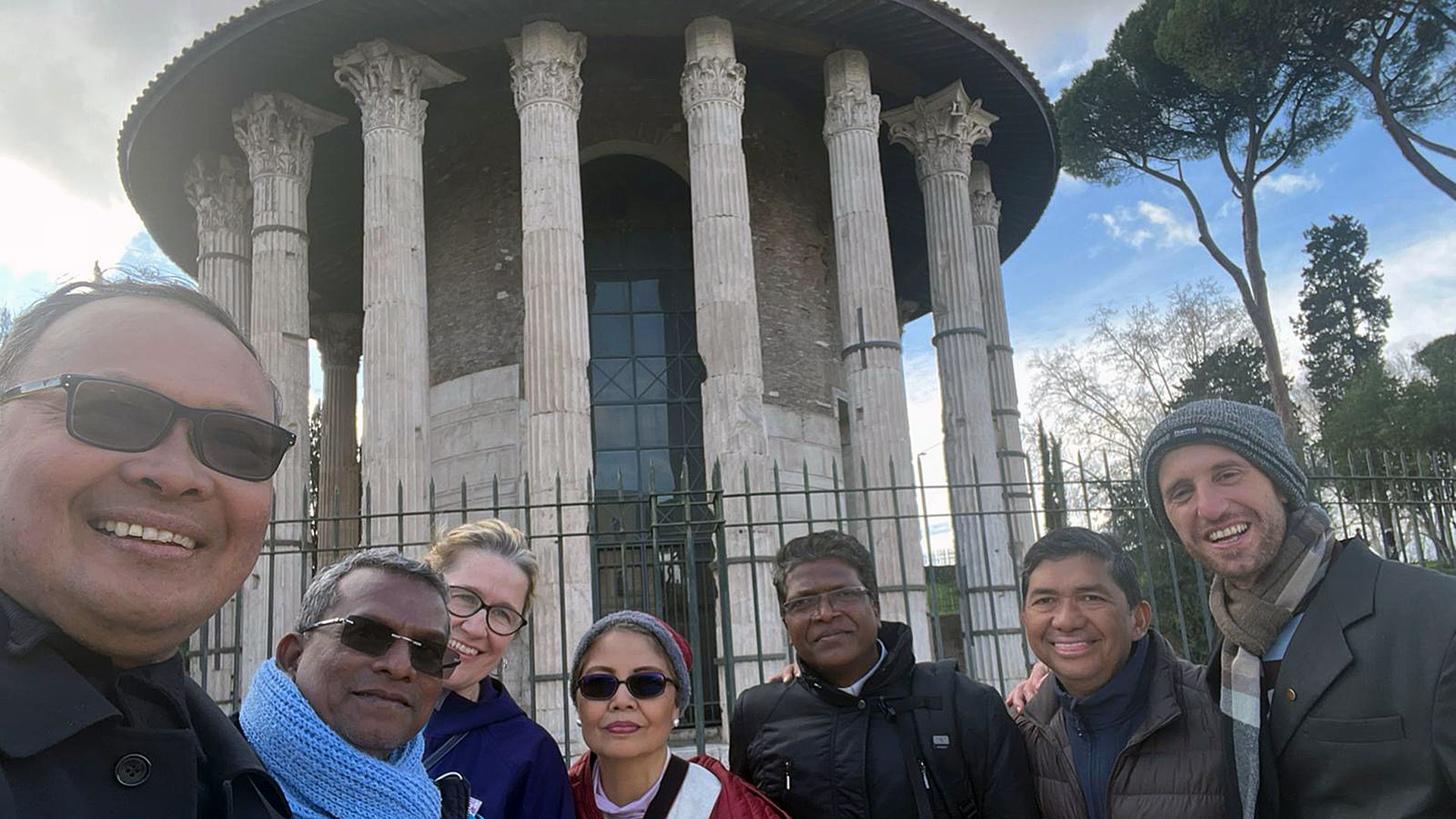
The Roman Adventure
By Dr. Carole Brown
Director of Sioux Spiritual Center
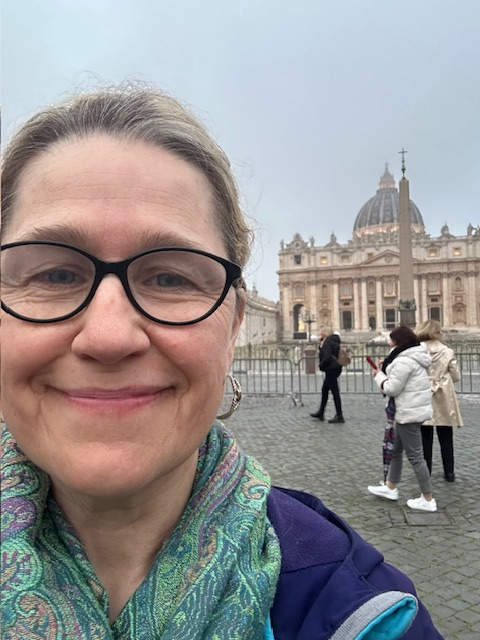
Going to Rome for four months was, without a doubt, one of the highlights of my life. I’ve lived in Europe before, and have visited Rome before – but I was never able to stay long enough to really get to know the city. Having the time to really learn my way around was a true gift. Not only was it the Great Jubilee Year of Hope, but to be there during such a historic time, when one pope passed the baton to the next, was just extraordinary. I was there at St. Peter’s for Pope Francis’s funeral, and I was there when the white smoke went up for our new pope. When Pope Leo was introduced, I didn’t understand what they said – and our phones were jammed, so I couldn’t check the internet. I was halfway home before I learned that he was an American. I was so surprised, I almost fell into the Tiber River!
I am grateful to the Board of the Sioux Spiritual Directors for encouraging me to go to Rome to study missiology at the Gregorian University, and to the Diocese of Rapid City for sponsoring me. Thanks also to Norma Tibbitts for looking after the SSC for the bulk of my time away, and to the great staff of the SSC for holding things together.
Why on earth would someone working at an out-of-the-way retreat center director get sent to Rome for four months to study? It’s a long story.
The primary mission of the Sioux Spiritual Center is to serve the special spiritual needs of Native American Catholics. The Jesuits, who built this place and ran it for 40 years, used to have a program called “Basic Directions,” which was designed as a kind of “orientation program” for missionary and diocesan personnel who would be working in native ministry settings. When Bishop Peter Muhich asked me if I would work on a redesign of the program, I met with some leaders in native ministry to get some input, and we soon realized that amongst all of us, there was very little to no training in the field of missiology.
“Missiology” is the field of academic study that looks at the Church’s approach to missionary work in cultures that are new to the Church. When St. Paul wrote his letter to the Romans, the Catholic Church was brand new to the Roman world. In chapter 11 of his letter, he was explaining to these Christians, who had only recently converted from their former way of worshipping multiple gods, how, in their new identity as Christians, they were related to the Jewish people. Using the metaphor of grafting trees, he described it as follows:
“… you, a wild olive shoot, were grafted in … to share the rich root of the olive tree … remember that it is not you that supports the root, but the root that supports you. You have been cut from what is by nature a wild olive tree and grafted, contrary to nature, into a cultivated olive tree. …”
This is a metaphor for the process of “inculturation.” Perhaps the idea of wild grapes is more familiar to us. Imagine grafting a wild grapevine into one of the vines in Napa Valley. The wild grapes bring some new characteristics to the cultivated vine, but even more so does the cultivated vine pour its life into the wild grapes, making them sweet and rich. You could say that “missiology” is about this process of grafting new families of peoples into the cultivated tree, rooted in Judaism and fulfilled in Catholicism.
You can also imagine how traumatic it must be for a wild olive branch or a wild grape branch to be cut off from the vine and grafted in. This was true of the Romans too. At first, the bigger culture of the Romans was not interested in what the Christians had to say. They made it illegal not to worship the Roman gods. They persecuted the Christians, and many of them laid down their lives as martyrs rather than renounce their faith in Jesus. But deep down, the Romans were impressed. And after a few hundred years, they were won over. As pagan Rome gradually became Christian, the Christians did not bulldoze the pagan temples, but founded churches on them. This is actually an apt metaphor for mission. The Church does not destroy cultures, but looks for the semina verba (seeds of the word) that are already present in the spiritual intuitions of the gentiles, from which bridges can be built. Now, Rome is arguably the most Catholic town in the world. Inculturation is a long and often painful process. And it is a process that the Church is extremely patient with.
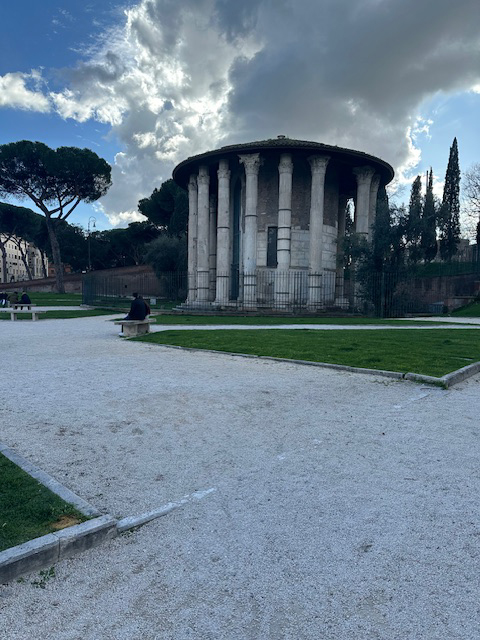
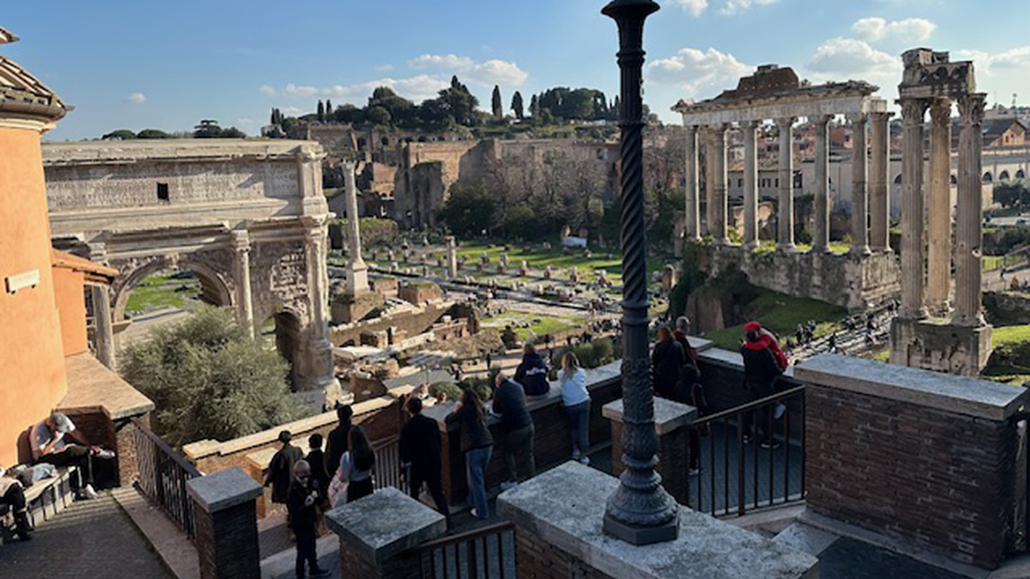
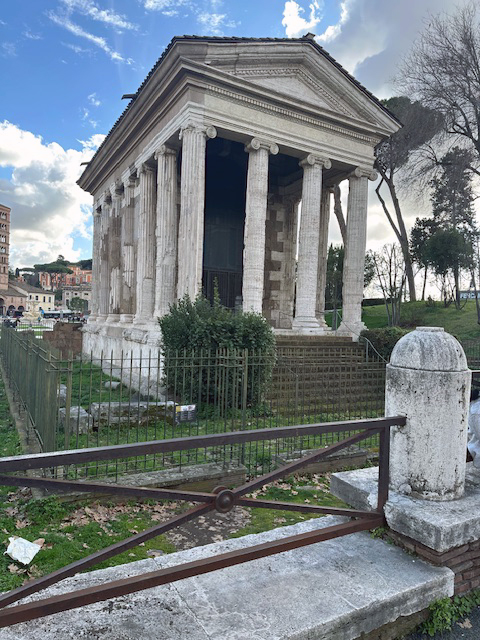
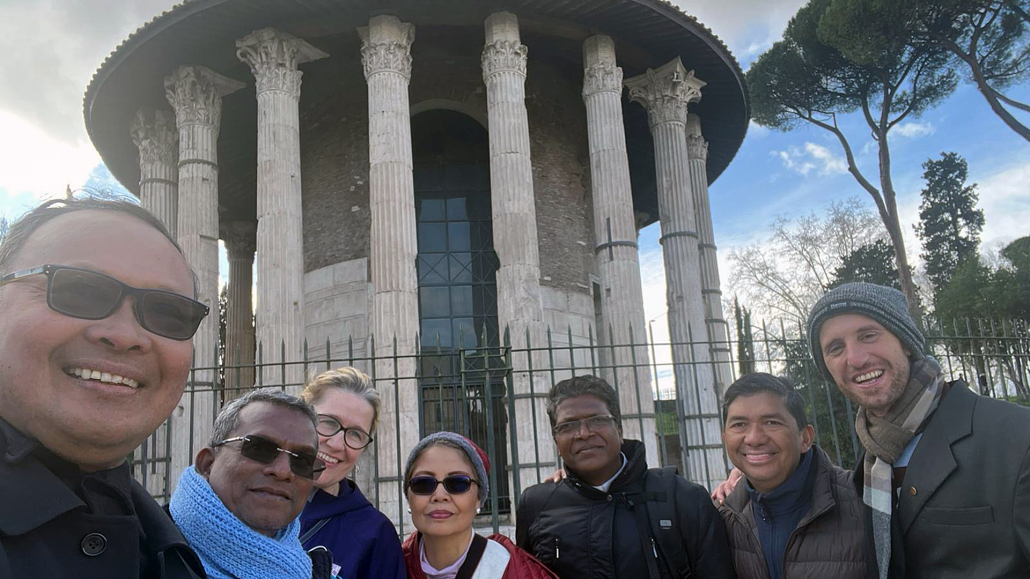
Every Friday, one of our professors took us on an excursion through ancient Rome, to see it through the lenses of mission. The remnants of the former way of life of the ancient Romans are all over that city. Some of their temples are still standing, like the famous Pantheon — now a church, officially named the Basilica of St. Mary and the Martyrs. Many Churches, and even the Gregorian University, are founded on the foundations of former pagan temples. Those former temples also present us with a good analogy of the work of inculturation. The various cultures of the world were able to intuit, on the basis of reason, certain “universal truths.” For example, the belief that there is a spiritual world, beyond the natural world; belief in life after death; belief in the value of sacrifice; love of wisdom; questing for truth. These foundational beliefs are perfectly Catholic — and they can be built on, whenever a new culture is brought into the Church.
Not everything from every culture fits, of course. Think of St Francis Xavier, when he first encountered a culture that practiced cannibalism, for example, or the human sacrifice of the Mayans. Those are the kinds of things that the process of inculturation seeks to purify. But every culture also brings new gifts into the Church. These are the things the Church treasures. This principle is aptly captured in the document from Vatican II, Nostra Aetate (Dialogue with Non-Christian Religions):
Likewise, other religions found everywhere try to counter the restlessness of the human heart, each in its own manner, by proposing “ways,” comprising teachings, rules of life, and sacred rites. The Catholic Church rejects nothing that is true and holy in these religions. She regards with sincere reverence those ways of conduct and of life, those precepts and teachings which, though differing in many aspects from the ones she holds and sets forth, nonetheless often reflect a ray of that Truth which enlightens all men.
And so, this four month sojourn in Rome has provided me with a much better orientation to the work at hand than what I had when I got here. And there are many more stories to tell about the Roman Adventure, if and when time permits.
More News
 https://www.rapidcitydiocese.org/wp-content/uploads/2021/10/IMG_0743.jpeg
800
1200
West River Catholic
https://www.rapidcitydiocese.org/wp-content/uploads/2022/02/WebHeader22-1.png
West River Catholic2021-10-14 09:31:572021-10-19 15:06:31Celebration of Marriage 2021
https://www.rapidcitydiocese.org/wp-content/uploads/2021/10/IMG_0743.jpeg
800
1200
West River Catholic
https://www.rapidcitydiocese.org/wp-content/uploads/2022/02/WebHeader22-1.png
West River Catholic2021-10-14 09:31:572021-10-19 15:06:31Celebration of Marriage 2021