Produced by the Office of Pastoral Ministries and Faith Formation
Morning Star Newsletter Monthly Reflection
April 2024
Subscribe below!
“What good are these for so many?”
Author: Sr. Sara Kowal, Director of Pastoral Ministries and Faith Formation
“What good are these for so many?” This question comes from the Gospel of John, chapter 6 in the very-familiar story in which Jesus miraculously multiplies the loaves and fish. Jesus challenges his Apostles to find food for the multitude, to which Philip replies, “Two hundred days’ wages worth of food would not be enough for each of them to have a little [bit]” (vs. 7). Andrew, however, having a little more faith, tentatively lets Jesus know that there is a boy present who has “five barley loaves and two fish.” Lest he appear overly confident or presumptuous of Jesus’ miraculous powers, he quickly adds, “But what good are these for so many?”
As disciples of Jesus trying to serve Him well, I think that we often feel like the Apostles – simply inadequate for the task before us. We see the “vast crowd,” see their needs, and know that we do not have what it takes to feed them. Like the Apostles, unfortunately, we also often lack faith in the power of Jesus. For it is true that what we “have” is simply not enough for the task before us. But what is also true is the fact that, if we give this “little” to Jesus, He will multiply it in a miraculous manner to provide for the needs of many.
I would like to share a true story with you to illustrate this point.* The story is of a young man who would have been considered a nominal catholic on a good day. Though he had faith, he did not do much more than the bare minimum to maintain it. Additionally, he had a lot of health issues. Socially, he was extremely introverted and would have been considered by most to be socially awkward – all of which amounted to a fair amount of social anxiety on his end. Young adulthood found him living with his parents and working with his dad due to his health issues. On one Sunday, as was his custom, he went to Mass with his parents. However, this Sunday was different. In the homily, his pastor said, “Every single one of us, not just some of us, but every one of us, has the capacity to become Saints.” He heard it and was inspired. He began to devour books on the interior life, and he learned about the rosary, which he began to pray daily. He would go to Church an hour early and stay an hour late. The pastor began to notice. The pastor also knew they needed a youth minister, so he reached out to the newly devout young man and invited him to consider the position. The man explained to Father that this simply would not be a good idea: “I am an extreme introvert, socially awkward, have profound anxiety, and so many health issues. I am simply not the man you are looking for.” But the pastor pressed and said he thought it should be him. The young man agreed to take the issue to prayer. After some time of discernment, he went back to his pastor and reluctantly agreed to take the youth ministry position. When the parish community heard the news, they were resistant. Why him? He clearly did not have the necessary skills to attract the youth. But the new youth minister began to wait outside of Mass each Sunday and invite other young men to the youth group. He didn’t really even have plans for the youth group – all they would do is pray the rosary. Week after week, he would teach them how to speak to God and how to listen to him. The group began to grow exponentially. One Sunday down the road, a young man came to Mass, filled with much grief. His father had just passed away; his mother and siblings had died when he was a child, leaving him now an orphan. He was all alone. His dad was a faith-filled man who never missed Mass or prayer, so when he was grieving and sad, he came to Mass. He was also struggling with his relationship with Mary. The new youth minister invited him to the youth group. In the group, he learned how to pray more deeply, he began to pray the rosary daily, and he began to deepen his relationship with Our Lady…. The fruit of this youth group is that 11 of the men became priests. 3 became bishops. 1 became the pope – Pope St. John Paul II, who was that young man who lost his family when he was 20 years old. Later in life, St. John Paul II shared that he attributed his vocation to two people in a particular way: first, his father, and second, his youth minister: Venerable Jan Tyranowski.
I am always deeply touched by the story of Venerable Jan Tyanowski. He was a man that, humanly speaking, had little to offer. But he made the decision to hand over this “little” to Jesus, trusting that Jesus could do with it something beyond his own capabilities. And Jesus did. He was faithful to Jan and his generosity. He miraculously multiplied the little Jan had and made it become something very big, very beautiful, and very fruitful.
Jan is not an anomaly. He is an example of what Jesus can and desires to do with every one of us. If we hand over the little we have, Jesus promises to do something miraculous with it. This is the divine pedagogy that God demonstrates over and over through the history of salvation: we don’t have what it takes, but when we give what we do have trustingly to the Lord (instead of keeping it for ourselves) he multiplies it. Think of the parable of the talents: invested, they multiply; stored away and hidden, they bear no fruit and serve no purpose. Yes, it is true that some were given more and others less. But Jesus does not seem to be concerned with this discrepancy. He is only concerned with what the owner does with what he has been given.
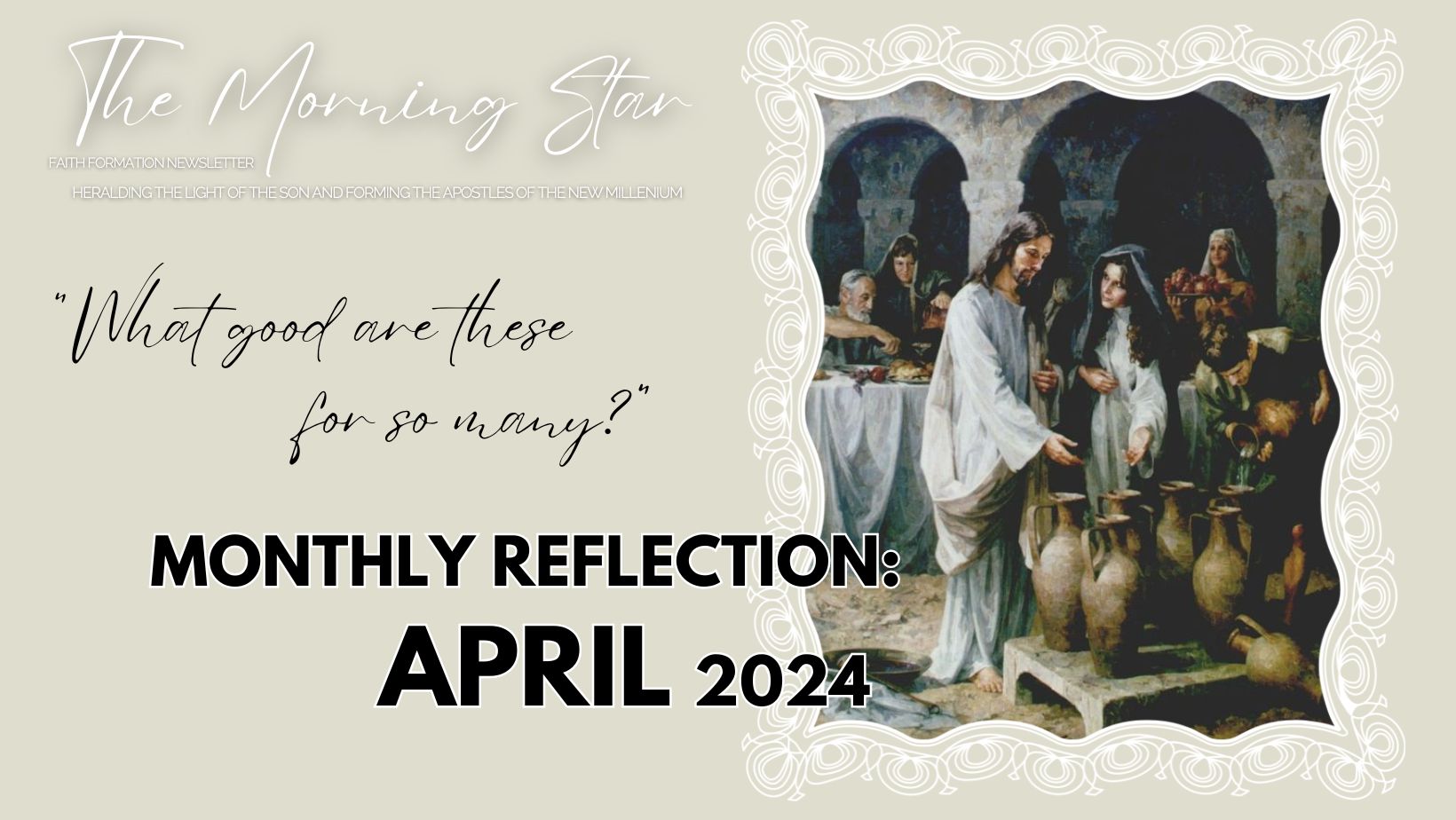
Think also of the Wedding at Cana. The servants are asked to fill up the water jugs with water. Interestingly, John gives us some details about these jugs. They are made of stone, and they can hold 25-30 gallons. There are 6 of them. In short, these are no small jugs. They also don’t have running water. They have a town well from which the water must be hauled (or the jugs must be hauled to the well). Regardless, filling the jugs is no easy task. It took some time and some hard labor. Yet we read that the servants filled the jugs “to the brim.” They did not slack in their task or get lazy. They fulfilled the command of Jesus to the best of their ability. But in the end, they only had water. They didn’t have wine, and they knew it. But they handed over this arduously acquired water to Jesus… and He performed a miracle.
However, what if the servants were lazy? What if they had not filled up the jugs at all? Or what if they had only filled them partially? It could be safely posited that Jesus would have done no miracle or a lesser one. The extent of the miracle – the amount of wine – depended on the extent that the servants were willing to get the water. The same is true for us. Jesus does not ask of us wine; he does not ask what is beyond our capacity to give. He asks us to be faithful with the water – what we can do – and then trustingly hand it over to him, knowing He does the miracle. But if we do not give Him our “water” He cannot make wine.
The Eucharist is the final example of this consistent divine pedagogy that I will offer. In the Mass, we offer the Lord bread and wine: “fruit of the earth and work of human hands.” We had to work to offer this bread and wine. We had to plant the seed, harvest the wheat and grapes and take them through the process of “grinding and squeezing” them into bread and wine. We truly do place the “work of human hands” upon the altar. But in the end, it is simply bread and wine…until it is offered to Jesus Christ and miraculously turned into his Body and Blood. Again, He does what we cannot, but He does not do it without our participation.
One last story to offer a real-life example: Blessed Solanus Casey (1870-1957). Solanus was born in Wisconsin to a poor large Irish family – he was one of 16 children. When he decided to be a priest, the journey was not an easy one. He was eventually accepted into the Capuchin Friars in Detroit. He struggled with academics and when he was finally ordained, he was ordained a “simplex” priest, unable to hear confessions or preach homilies. This seemingly “ignorant” priest was assigned to be the porter instead. It was here, answering the door and talking to the people, that Fr. Solanus became a beloved counselor and great intercessor. Many miracles began to occur through his intercession. On average, 150-200 people came to visit him daily, asking for his advice and prayers. When poor health directed his superiors to send him to Huntington, Indiana to “retire,” busloads of people would travel to find him there simply so they could ask for his prayers. After his death in 1957, the influx of miracles continued, and he is known today as a great and miraculous intercessor. At his beatification ceremony in 2017, Ford Field in Detroit was filled to capacity. All this for a “simplex” priest who was not seemingly smart enough to hear confessions or preach homilies. But like Venerable Jan Tyranowski and countless other men and women deemed “untalented” in the world’s eyes, he gave the Lord the little he had and trusted that it was enough. And it was.
“What good are these for so many?” We may ask the same question ourselves regularly. “Lord, you know the little I have. You know my weaknesses and my lackings, yet you set before me a great multitude of people to feed. How can you expect me to provide?” Hopefully, we can walk away today with a little more assurance of His great mercy, love and power. Hopefully, we can decide to have a little more trust that if we offer Him that “little,” He will do miracles in and through us.
I leave you with the words of Our Lady to St. Juan Diego when he protested that he was too “insignificant” and begged her to send someone more “known, respected and esteemed” with her message to the Bishop. Let us hear these words of our Mother in our own hearts too:
“Listen, smallest of my children…I have many servants that I can ask to do my will…but I specifically need you… Let your heart not be disturbed. Do not be afraid… Am I not here who am your Mother?”
May we trust that what we have is enough when we give it to Him.
* This story is an adaption of the original story that was delivered by Fr. Josh Johnson in Miami at the IV International Eucharistic-Marian Congress on October 7-9, 2022.
Subscribe to our new Faith Formation newsletter, The Morning Star!
This bi-monthly newsletter will be delivered right to your inbox and will contain summarized information on upcoming events from the office of Faith Formation and Pastoral Ministries, news and updates, ideas on living-out the liturgical year, upcoming feast days and celebrations, and a monthly reflection.