
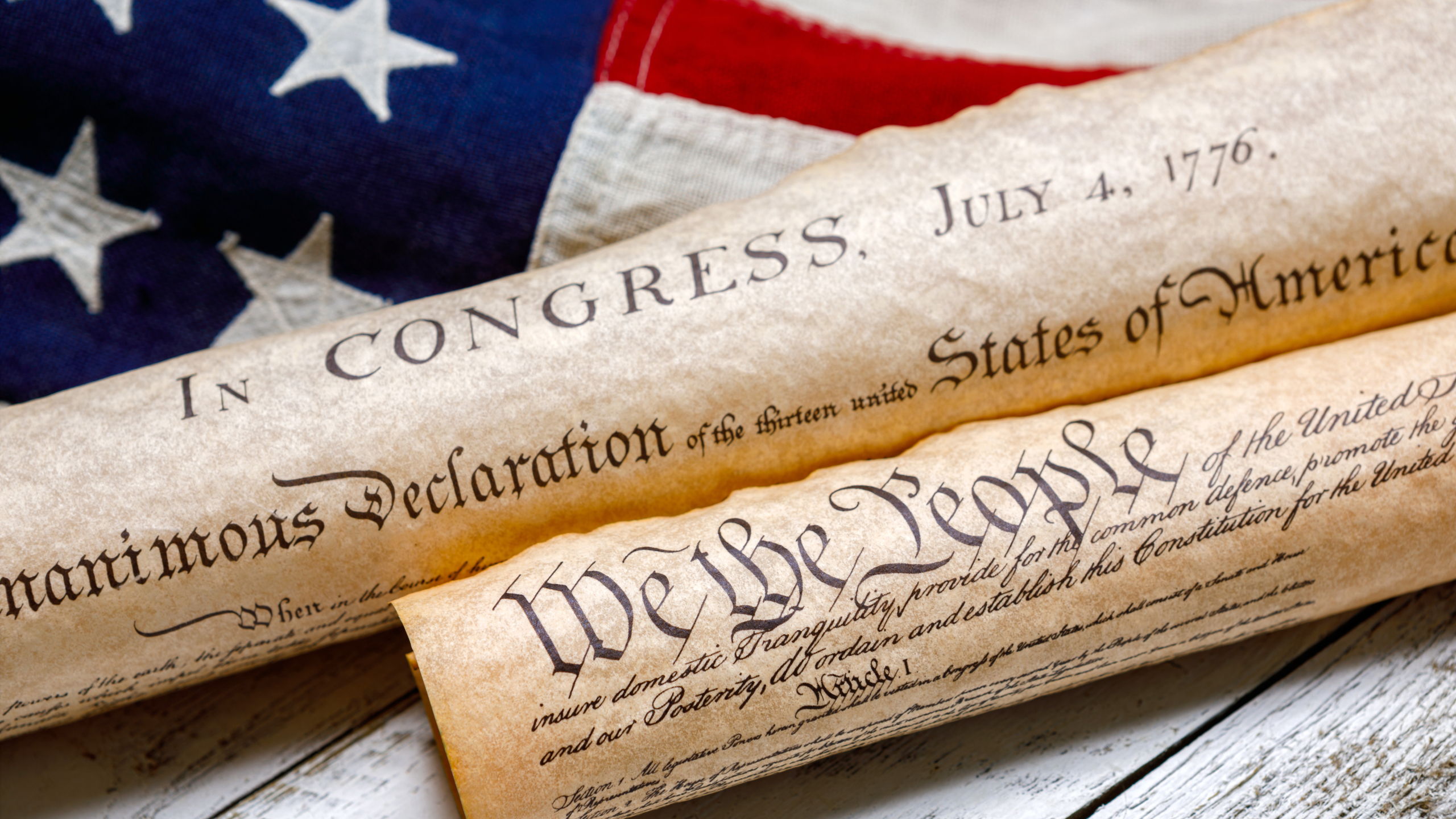
‘Catholic priests risked imprisonment or execution’
Congress shall make no law respecting an establishment of religion, or prohibiting the free exercise thereof; or abridging the freedom of speech, or of the press; or the right of the people peaceably to assemble, and to petition the Government for a redress of grievances.” First Amendment to the United States Constitution, adopted 1791.
The First Amendment to the United States Constitution enshrines a number of rights that we take for granted: freedom of religion, freedom of speech, freedom of the press, right to assembly, and a right to legal recourse when aggrieved. In this ongoing series of articles on the 250th anniversary of our nation from the perspective of our Catholic faith, it is the first two clauses of this amendment that will be the focus here: “Congress shall make no law respecting an establishment of religion (“the establishment clause”), or prohibiting the free exercise of (“the free exercise clause”) …” The implication of these first two clauses of the first amendment to the Constitution is that this right was under attack and needed legal protection. Our Catholic ancestors knew this well!
For example, in the Massachusetts Bay Colony (which was founded by Puritans), Catholics were not allowed to practice their religion openly and priests could be arrested or even banished. In Virginia, anti-Catholic laws that originated in the English Reformation were followed in this English colony, making Catholic worship illegal for long periods. And, in New York, which also followed English law, restrictions became even more strict with an anti-Catholic uprising of 1689, after which Catholic priests risked imprisonment or execution even by being present in the colony.
The major exception was Maryland, whose “Toleration Act” of 1649, framed by the colony’s Roman Catholic proprietor, Lord Baltimore (Cecil Calvert), was the first public act to use the phrase “the free exercise” of religion, later embodied in the first amendment. This freedom, however, was a tenuous one.
Opposition to the Act by Protestant leaders of the colony managed to bring about its suspension between 1654 and 1658, and when they gained political control of the colony in 1689, the act was rescinded permanently, after which the public exercise of the Catholic religion was banned never to be reinstated under colonial rule.
Some of our founding fathers too exhibited such anti-Catholic hostility — though not all. John Adams, one of the most virulent, in a letter to Thomas Jefferson in 1821, said, “Can a free government possibly exist with the Roman Catholic religion?” Though he believed Catholic bishops encouraged political authoritarianism, he at the same time supported legal toleration of Catholics. His second cousin Samuel Adams spoke in the manner of many when he said, “What we have above everything else to fear is Popery.” Finally, John Witherspoon, the signer of the Declaration of Independence and a Presbyterian minister from New Jersey spoke to the heart of the concerns of many when he wrote, “Popery is not tolerated … because they profess entire subjection to a foreign power, the see of Rome.” The issue was often that allegiance of Catholics to Rome would undermine the stability of the independent United States.
However, not all were as strident as these founders. Our first president, George Washington, on the eve of the adoption of the Bill of Rights (the first of which being the First Amendment to the Constitution) said, in a letter to American Catholics (1790), “As mankind becomes more liberal they will be more apt to allow that all those who conduct themselves as worthy members of the community are equally entitled to the protection of civil government.”
Furthermore, as previously mentioned, with the participation of Marylander and Catholic, Charles Carroll in the deliberations and signing of the Declaration of Independence, Catholics had, at least nominally, a place at the political table of the founders.
Needless to say, the competing interests of the first two clauses of the First Amendment (the State could not establish religion while the citizens had the right to exercise their religion freely) have had to be worked out, both politically and legally, across the course of our 250 years. For example, the Supreme Court in McCreary County v. American Civil Liberties Union (2005) clarified this tension in the following situation: When the government spends money on the clergy (military chaplains), then it looks like establishing religion. But, if the government cannot pay for military chaplains, then many soldiers and sailors would be kept from the opportunity to exercise their chosen religions.
The right to free exercise of religion in the Constitution of the United States has had far reaching effect, including the inspiration of similar protections in the modern constitutions of India (1950), Germany (1949), post-apartheid South Africa (1996), just to name a few.
In a real way, the right to Religious Liberty in the Constitution can be seen as a clear ancestor to the Universal Declaration of Human Rights (1948), adopted by the United Nations which states, “Everyone has the right to freedom of thought, conscience and religion; this right includes freedom to change his religion or belief, and freedom … to manifest his religion or belief in teaching, practice, worship and observance,” and even to the Church’s own Declaration Dignitatis Humanae of Religious Liberty of the Second Vatican Council (1965) which noted, “Indeed, religious freedom has already been declared to be a civil right in most constitutions, and it is solemnly recognized in international documents” (DH 15).
As we will see in subsequent articles in this series, the guarantees in the U.S. Constitution did not in fact remove all prejudices to Catholics and the practice of their religion in subsequent years. But for now, it is a worthy thing to be grateful to the relative freedom we Catholics (and other believers) have in our nation. At the same time, we continue to pray for the full preservation of this basic human right in our nation … and all around the world.
Next month: The Early Republic and the Carroll Family
More News
 https://www.rapidcitydiocese.org/wp-content/uploads/2026/08/bishop-august-column-scaled.jpg
1440
2560
Becky Berreth
https://www.rapidcitydiocese.org/wp-content/uploads/2022/02/WebHeader22-1.png
Becky Berreth2026-08-19 15:13:102026-08-19 16:02:39The Great Depression and the New Deal
https://www.rapidcitydiocese.org/wp-content/uploads/2026/08/bishop-august-column-scaled.jpg
1440
2560
Becky Berreth
https://www.rapidcitydiocese.org/wp-content/uploads/2022/02/WebHeader22-1.png
Becky Berreth2026-08-19 15:13:102026-08-19 16:02:39The Great Depression and the New Deal https://www.rapidcitydiocese.org/wp-content/uploads/2026/08/Black-Elk-CRC-20-scaled.jpg
1707
2560
Becky Berreth
https://www.rapidcitydiocese.org/wp-content/uploads/2022/02/WebHeader22-1.png
Becky Berreth2026-08-18 11:00:172026-08-19 14:49:1350 years of ministry
https://www.rapidcitydiocese.org/wp-content/uploads/2026/08/Black-Elk-CRC-20-scaled.jpg
1707
2560
Becky Berreth
https://www.rapidcitydiocese.org/wp-content/uploads/2022/02/WebHeader22-1.png
Becky Berreth2026-08-18 11:00:172026-08-19 14:49:1350 years of ministry https://www.rapidcitydiocese.org/wp-content/uploads/2026/08/DSC_2729.jpg
630
1200
Becky Berreth
https://www.rapidcitydiocese.org/wp-content/uploads/2022/02/WebHeader22-1.png
Becky Berreth2026-08-15 11:00:032026-08-14 15:12:25Surgite Eamus Dinner Celebrates Vocations
https://www.rapidcitydiocese.org/wp-content/uploads/2026/08/DSC_2729.jpg
630
1200
Becky Berreth
https://www.rapidcitydiocese.org/wp-content/uploads/2022/02/WebHeader22-1.png
Becky Berreth2026-08-15 11:00:032026-08-14 15:12:25Surgite Eamus Dinner Celebrates Vocations https://www.rapidcitydiocese.org/wp-content/uploads/2026/06/Catechetical-Kickoff-2026-FB-Event-scaled.png
1440
2560
Becky Berreth
https://www.rapidcitydiocese.org/wp-content/uploads/2022/02/WebHeader22-1.png
Becky Berreth2026-08-14 11:00:352026-08-24 09:44:53Catechetical Kick-Off: A desire to grow in faith
https://www.rapidcitydiocese.org/wp-content/uploads/2026/06/Catechetical-Kickoff-2026-FB-Event-scaled.png
1440
2560
Becky Berreth
https://www.rapidcitydiocese.org/wp-content/uploads/2022/02/WebHeader22-1.png
Becky Berreth2026-08-14 11:00:352026-08-24 09:44:53Catechetical Kick-Off: A desire to grow in faith https://www.rapidcitydiocese.org/wp-content/uploads/2026/08/048A8410.jpg
1152
2048
Becky Berreth
https://www.rapidcitydiocese.org/wp-content/uploads/2022/02/WebHeader22-1.png
Becky Berreth2026-08-12 09:37:002026-08-12 14:20:32Dedication and Blessing of St. Rose of Lima
https://www.rapidcitydiocese.org/wp-content/uploads/2026/08/048A8410.jpg
1152
2048
Becky Berreth
https://www.rapidcitydiocese.org/wp-content/uploads/2022/02/WebHeader22-1.png
Becky Berreth2026-08-12 09:37:002026-08-12 14:20:32Dedication and Blessing of St. Rose of Lima https://www.rapidcitydiocese.org/wp-content/uploads/2026/03/Becoming-One-Banner.png
1080
1920
Becky Berreth
https://www.rapidcitydiocese.org/wp-content/uploads/2022/02/WebHeader22-1.png
Becky Berreth2026-08-11 11:00:172026-08-11 14:44:36A chance to reconnect
https://www.rapidcitydiocese.org/wp-content/uploads/2026/03/Becoming-One-Banner.png
1080
1920
Becky Berreth
https://www.rapidcitydiocese.org/wp-content/uploads/2022/02/WebHeader22-1.png
Becky Berreth2026-08-11 11:00:172026-08-11 14:44:36A chance to reconnect https://www.rapidcitydiocese.org/wp-content/uploads/2026/08/web-renewal-scaled.jpg
1440
2560
Becky Berreth
https://www.rapidcitydiocese.org/wp-content/uploads/2022/02/WebHeader22-1.png
Becky Berreth2026-08-07 11:00:252026-08-07 16:34:51Sr. Lorane Coffin, OSB, celebrates 75 years
https://www.rapidcitydiocese.org/wp-content/uploads/2026/08/web-renewal-scaled.jpg
1440
2560
Becky Berreth
https://www.rapidcitydiocese.org/wp-content/uploads/2022/02/WebHeader22-1.png
Becky Berreth2026-08-07 11:00:252026-08-07 16:34:51Sr. Lorane Coffin, OSB, celebrates 75 years https://www.rapidcitydiocese.org/wp-content/uploads/2026/08/IMG_7370-scaled.jpg
1440
2560
Becky Berreth
https://www.rapidcitydiocese.org/wp-content/uploads/2022/02/WebHeader22-1.png
Becky Berreth2026-08-05 11:47:312026-08-05 13:29:51Deacon Ben Black Bear celebrates 50 years
https://www.rapidcitydiocese.org/wp-content/uploads/2026/08/IMG_7370-scaled.jpg
1440
2560
Becky Berreth
https://www.rapidcitydiocese.org/wp-content/uploads/2022/02/WebHeader22-1.png
Becky Berreth2026-08-05 11:47:312026-08-05 13:29:51Deacon Ben Black Bear celebrates 50 years https://www.rapidcitydiocese.org/wp-content/uploads/2026/08/e9397c57-ac37-4337-a4e5-8f133751fc58-copy.jpg
784
1392
Becky Berreth
https://www.rapidcitydiocese.org/wp-content/uploads/2022/02/WebHeader22-1.png
Becky Berreth2026-08-04 11:00:442026-08-05 14:33:02Steubenville St. Paul 2026
https://www.rapidcitydiocese.org/wp-content/uploads/2026/08/e9397c57-ac37-4337-a4e5-8f133751fc58-copy.jpg
784
1392
Becky Berreth
https://www.rapidcitydiocese.org/wp-content/uploads/2022/02/WebHeader22-1.png
Becky Berreth2026-08-04 11:00:442026-08-05 14:33:02Steubenville St. Paul 2026